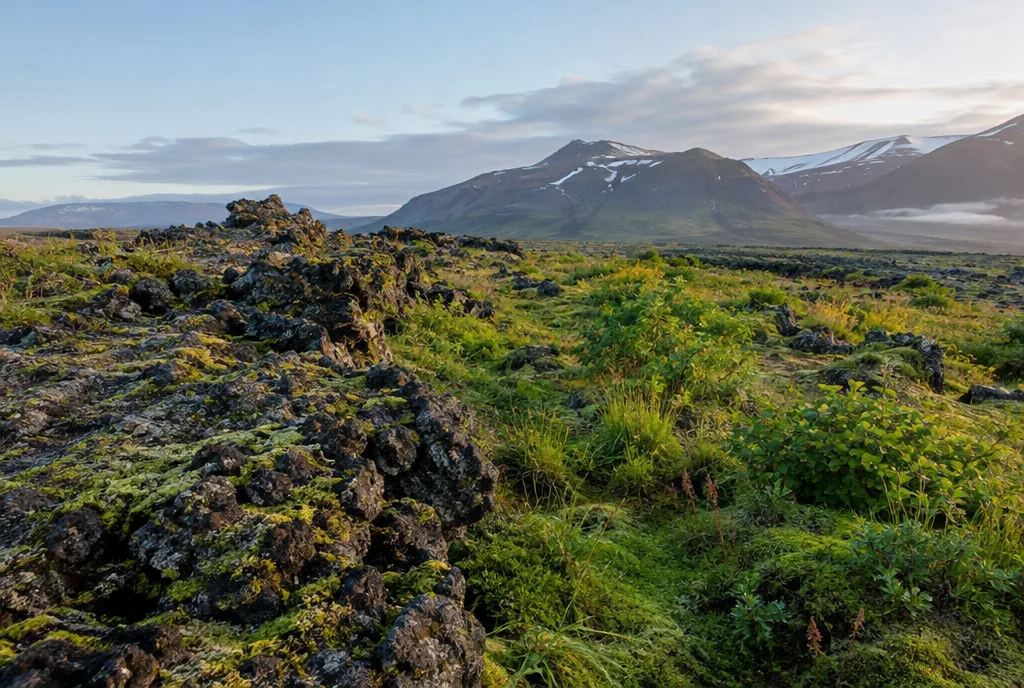
Ecological succession is the directional, often predictable change in the species composition of a community over time. It begins when changing conditions or a disturbance opens space and releases resources such as light, water, and nutrients. Some sites must build soil from bare rock; others recover from surviving roots, seeds, and organic matter. That difference explains why a new volcanic island and an abandoned farm field can both change dramatically, yet follow very different ecological clocks.
What ecological succession means for a changing community
In its shortest useful form, succession is the step-by-step replacement of one community by another after a disturbance or environmental change. A community is all the populations of different species living in the same place at the same time, connected through food webs, competition, and facilitation. As that community changes, its population structure changes with it, as do resources such as soil nitrogen.
The main cause of succession is disturbance: an event that partly or completely removes the existing community and makes resources available to colonists. Fire, flooding, clearcutting, abandoned agriculture, and newly exposed lava do not produce the same result, because each leaves a different starting point. Landscape context, land use, physical conditions, available species, species performance, and feedback from the plant community also shape the path that follows.
Early stages often favor species that reproduce quickly and have short life spans. Later stages commonly favor longer-lived, stronger competitors. Ecologists Joseph Connell and Ralph Slatyer described three ways the handoff can happen:
- Facilitation: an early species changes the site so that another species can establish.
- Inhibition: an early occupant blocks later colonists until it dies or is removed.
- Tolerance: later species persist because they can compete under the conditions already present.
Frederic Clements divided succession into six linked phases: nudation, or exposure of a site; migration; ecesis, or establishment; competition; reaction, in which organisms alter the site; and stabilization. The terminology is historical, but the sequence still makes a useful point: organisms do not merely arrive in a place. They change it for the organisms that follow.
Primary succession builds soil where none exists
Primary succession starts on a surface that has no vegetation, soil, or seed bank. Bare rock, fresh lava flows, glacier forefields, and newly deposited sand dunes are classic examples. Because there is no ready-made soil and no buried reserve of seeds, colonists must arrive from elsewhere and begin altering a difficult substrate.
Lichens, algae, and mosses are among the first settlers. Lichens such as Stereocaulon can weather rock physically and chemically, while other early organisms trap particles and add organic material. Gradually, this work creates the first humus layers. Young soils contain very little nitrogen, so nitrogen-fixing pioneers can have an outsized effect. Alders (Alnus) and lupines such as Lupinus lepidus help enrich the substrate and make establishment possible for other plants.
The pace can be very slow. On a lava surface, development of a closed soil and herbaceous vegetation can take 100 to 1,000 years. Diversity usually rises during early primary succession as more species find suitable microsites. It may decline again in later stages when strong competitors exclude weaker ones.
Surtsey shows how a sterile island acquires life
When submarine eruptions formed the Icelandic island of Surtsey between 1963 and 1967, the new land was initially sterile. In 1965, the first vascular plant, sea rocket (Cakile maritima), was recorded there. By 2020, about 80 vascular plant species, including dwarf shrubs and willow species, had become established. The example shows primary succession at work: new land can begin as fresh volcanic material, then accumulate colonists one arrival at a time. As soil nitrogen and competition change, the community changes with them.
Secondary succession recovers faster because the site remembers
Secondary succession occurs where vegetation has existed before and a disturbance exposes some or all of the site. A fire, flood, clearcut, or abandoned field may remove plants above ground, but soil, organic matter, seed banks, and root fragments often remain. These biological legacies are why secondary succession is generally much faster than primary succession.
An old field in the United States offers a recognizable sequence. Pioneer herbs occupy exposed ground in years 1 and 2. Annual grasses occur from years 1 through 13, perennial bunchgrasses become prominent from years 10 through 20, and a closed prairie vegetation with shrubs follows. Long-term evidence from ten New Jersey old fields has been collected since 1958 through 48 permanent one-meter plots in each field. In Minnesota, an 88-year study found that old-field species composition changed deterministically rather than randomly, shaped by site conditions, competition, and demographic trade-offs.
| Question | Primary succession | Secondary succession |
|---|---|---|
| What is left at the start? | Bare substrate without soil or a seed bank | Soil, seed bank, roots, and organic material are largely retained |
| Where can it begin? | Fresh lava, bare rock, glacier forefields, or new dunes | After fire, clearcutting, flooding, or field abandonment |
| Who arrives first? | Lichens, algae, mosses, then herbs and woody plants | Herbs, grasses, resprouting plants, and species from the seed bank |
| Why does it differ in speed? | Soil and nutrient pools must first be built | Surviving biological legacies jump-start recovery |
| Typical full time scale | About 500–1,000 years to climax forest | About 100–200 years to climax forest |
Examples make the difference between the two pathways visible
Glacier Bay, Alaska, illustrates a primary-succession sequence after glacier retreat. Fresh moraines first support mosses and lichens, followed by dwarf willows. Alders appear after 30 to 50 years; Sitka spruce follows after 80 to 120 years; and hemlock appears after 150 or more years. Each stage changes the growing conditions for the next one.
Mount St. Helens demonstrates why a single disaster can create both forms at once. Its May 18, 1980 eruption ejected 1.3 cubic kilometers of material, leveled 600 square kilometers of forest, and left a 60-square-kilometer debris avalanche. Some patches were stripped so thoroughly that they began primary succession, while other patches retained soil or organisms and recovered through secondary succession. Within 10 years, almost all mammal species from the southern Washington Cascades had returned to the catastrophically disturbed area. Prairie lupine added nitrogen, and pocket gophers (Thomomys talpoides) moved soil; both helped make conditions suitable for more plants. Windborne spiders were recorded in the ash field only days after the eruption.
Fire can also begin secondary succession without erasing the ecological past. After a California wildfire, annual wildflowers including Phacelia species and California poppy (Eschscholzia californica) can return within one to two years. Shrubs such as Ceanothus may dominate after five to 10 years, while pines can appear after 30 to 50 years. The sequence is not a universal schedule; it is an example of how surviving soil and propagules change the pace.
Pioneer species alter the conditions that follow them
Pioneer species are the first organisms to occupy an uncolonized habitat. They tend to produce many seeds, disperse efficiently by wind or animals, and tolerate ultraviolet radiation, drought, and nutrient scarcity. Some lichen spores measure only 5 to 20 micrometers and can travel hundreds of kilometers, an advantage when a new surface is far from an established community.
On bare rock, crustose lichens in the genera Rhizocarpon and Lecidea dissolve minerals with acids and begin weathering. On dunes, beach grass (Ammophila arenaria) stabilizes sand with deep roots. These are not simply early names on a species list: their activity changes erosion, organic matter, and the availability of places where later species can grow.
Biological legacies make the contrast especially clear. Surviving organisms, seed banks, dead wood, and root systems influence the speed and direction of recolonization. Where they remain, recovery can draw on local material. Where they are absent, the site depends more heavily on long-distance dispersal and on pioneers that build the first soil and nutrient pools.
A climax community is a useful idea, not a permanent finish line
Clements described the climax community as a stable final stage in equilibrium with regional climate. In that view, succession was a deterministic developmental process. The concept remains useful for asking what community might persist under a particular climate and disturbance regime, but ecologists no longer treat climax as a universal, fixed endpoint.
Henry Chandler Cowles, whose 1899 work on Lake Michigan dunes helped found dynamic ecology, argued that succession never reaches a true equilibrium. Henry Gleason likewise described plant communities as an individual continuum rather than units with sharp boundaries. The polyclimax theory goes further: climate, soils, fire, and grazing can support several relatively stable end states within a region. On deep, moist soils in temperate North America, beech-maple forest (Fagus grandifolia–Acer saccharum) is often treated as a regional climax community. That does not mean every local site must become one or remain one forever.
Human actions and climate change can redirect succession
People can hold ecosystems in early stages or send them down new paths. Agriculture repeatedly plows and harvests vegetation, maintaining an early successional condition; an abandoned field begins secondary succession immediately. Cattle and sheep grazing selectively favors grazing-resistant plants such as thistles and thorny shrubs while limiting browse-sensitive woody plants, potentially holding a site in a grassland phase for decades. Roads, settlement, and clearcuts can fragment a landscape and prevent some later-successional species from reaching a site.
Fire policy is another powerful intervention. Indigenous peoples in North America used controlled surface fires for millennia. Since 1900, fire suppression in the United States has produced denser forests in some Rocky Mountain pine systems and shifted fire regimes toward severe crown fires. The disturbance that follows is therefore different from the one the community had historically experienced.
Invasive cheatgrass (Bromus tectorum) shows how feedback can lock in a new path. In Great Basin steppe, it has shortened fire-return intervals from 60–100 years to 3–5 years, blocking the return of native species and creating a fire-dependent dynamic. Climate change adds another source of redirection: drought, more frequent and intense wildfires, heavy rain, and pest outbreaks can reset the successional clock. In Denali, Alaska, treeline has moved more than 150 meters upslope in places since 1953, bringing trees into formerly treeless alpine tundra habitat.
Three misconceptions obscure what succession really does
“Succession always ends in a forest.”
Not necessarily. The outcome depends on climate, soil, fire, grazing, and other local conditions. A community may remain grassland or shrubland, and frequent disturbance can prevent a forest stage from developing.
“Predictable means every site has the same future.”
Predictable means that species traits, competition, and environmental conditions can produce recognizable patterns. It does not mean a rigid script. Species availability, surviving legacies, and changing disturbance regimes can lead similar sites in different directions.
“Disturbance only destroys ecosystems.”
Disturbance removes organisms and releases resources, which is why it starts succession. Its effects can be damaging, especially when intensified by people or invasive species, but it also creates the openings that sustain early-stage species and new community combinations.
Frequently Asked Questions
What is ecological succession in one sentence?
Ecological succession is the gradual replacement of species in a community as organisms respond to and alter changing environmental conditions.
What is succession short answer?
It is the biological recovery and change of an area after disturbance, from pioneer species toward a potential later-stage community.
What is the main cause of succession?
Disturbance is the main cause because it removes part or all of a community and releases resources such as light, water, and nutrients for new colonists.
Can you give me an example of ecological succession?
On Surtsey, a sterile volcanic island formed from 1963 to 1967, sea rocket was recorded in 1965 and about 80 vascular plant species had established by 2020.
What is the difference between primary and secondary succession?
Primary succession begins without soil or a seed bank, while secondary succession begins where soil and biological legacies remain after a disturbance.
Does succession always reach a climax community?
No. The climax idea describes a possible relatively stable state, but disturbances and changing conditions mean many communities never reach one fixed endpoint.