No species lives alone. Every plant, animal, fungus and microbe is linked to others through feeding, competition, shelter and cooperation. Ecologists classify these relationships by their effect on each partner: positive, negative or neutral. Together they form the networks that hold ecosystems together. This article explains the main types of ecological interactions, gives well-studied examples, and looks at one of the most remarkable partnerships between humans and a wild animal.
Mutualism: both partners benefit
In a mutualism, each species gains something from the other. Pollination is the most familiar case. Bees, butterflies, hummingbirds and bats collect nectar or pollen as food and in return carry pollen from flower to flower, allowing plants to reproduce. Roughly three quarters of the world’s leading food crops benefit at least in part from animal pollination.
Other examples:
- Mycorrhizal fungi: fungal threads grow into or around the roots of most land plants, supplying water and phosphorus in exchange for sugars from photosynthesis.
- Clownfish and sea anemones: the fish shelters among stinging tentacles that deter predators, while it chases away fish that eat anemones and provides nutrients through its waste.
- Cleaner fish: cleaner wrasses remove parasites from larger fish at reef “cleaning stations.”
- Nitrogen-fixing bacteria: bacteria in the root nodules of beans and other legumes turn atmospheric nitrogen into a form plants can use.
Some mutualisms are obligate, meaning neither partner can survive without the other, such as figs and their specialized fig wasps. Others are facultative, useful but not essential.
Commensalism: one benefits, the other is unaffected
In commensalism one partner gains while the other is neither helped nor harmed. Cattle egrets follow grazing cattle and catch the insects stirred up from the grass; the cattle are largely unaffected. Barnacles attach to whales and gain transport through food-rich waters. Epiphytic orchids and bromeliads grow on the branches of rainforest trees to reach light without drawing nutrients from their hosts.
True commensalism is hard to prove, because closer study often reveals a small benefit or cost. Heavy loads of epiphytes, for instance, can break branches.
Competition: both lose
Competition occurs when two organisms need the same limited resource, such as food, water, light or nesting sites. Both are worse off than they would be alone. Competition can occur within a species or between species.
In the 1930s the Russian biologist Georgy Gause grew two species of Paramecium, single-celled organisms, in the same culture. When they fed on the same bacteria, one species always drove the other to extinction. This became known as the competitive exclusion principle: two species competing for exactly the same resources cannot coexist indefinitely. In nature, competing species often divide resources instead, feeding at different times, heights or on different prey. The ecologist Robert MacArthur showed in 1958 that five species of warblers in New England spruce forests feed in different parts of the same trees.
Predation, herbivory and parasitism: one gains, one loses
Predation
A predator kills and eats its prey. Predator and prey populations often influence each other’s numbers. The lynx and snowshoe hare of northern Canada are the classic case: fur trade records kept by the Hudson’s Bay Company show population cycles of about ten years, with lynx numbers following hare numbers up and down.
Herbivory
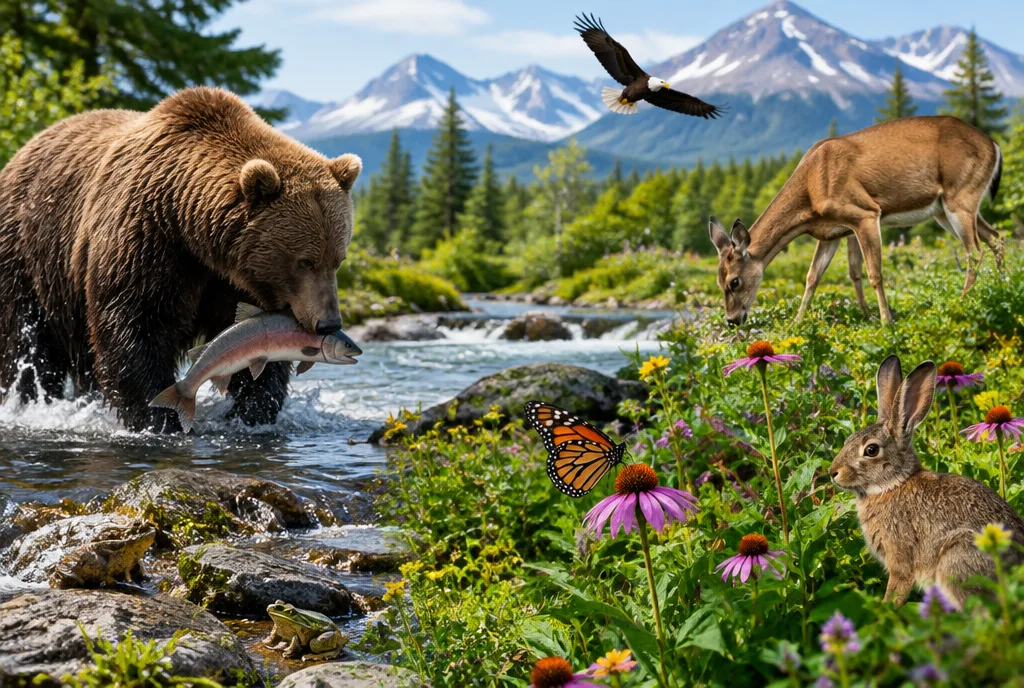
Herbivores eat plants or parts of plants, usually without killing them. Plants respond with thorns, tough leaves and chemical defenses such as tannins, caffeine and nicotine. Herbivores in turn evolve ways to tolerate these toxins. Monarch butterfly caterpillars, for example, feed on milkweed and store its toxins, which makes them poisonous to birds.
Parasitism
A parasite lives on or in a host and draws resources from it, usually without killing it quickly. Ticks on deer, tapeworms in mammals and mistletoe on trees are examples. Some parasites alter their hosts’ behavior: the fungus Ophiocordyceps makes infected ants climb vegetation before it kills them and releases spores.
Amensalism: one harmed, the other unaffected
In amensalism one species is harmed while the other is not affected. The mold Penicillium releases substances that kill nearby bacteria, the observation that led Alexander Fleming to penicillin in 1928. Black walnut trees release a compound called juglone that inhibits the growth of many plants beneath them. A herd of elephants trampling small plants on its way to water is another example.
Overview of interaction types
| Interaction | Species A | Species B | Example |
|---|---|---|---|
| Mutualism | + | + | Bees and flowering plants |
| Commensalism | + | 0 | Cattle egrets and cattle |
| Competition | − | − | Two Paramecium species |
| Predation | + | − | Lynx and snowshoe hare |
| Herbivory | + | − | Caterpillars and milkweed |
| Parasitism | + | − | Ticks and deer |
| Amensalism | 0 | − | Penicillium mold and bacteria |
Coevolution
When two species interact closely over long periods, each can drive evolutionary change in the other. This is coevolution. Long-tongued moths and flowers with deep nectar spurs, fast cheetahs and fast gazelles, and plants with new toxins and insects that detoxify them are all products of such reciprocal change. Charles Darwin predicted in 1862 that an orchid from Madagascar with a nectar spur nearly 30 centimeters long must be pollinated by a moth with a tongue of similar length. The moth was described in 1903.
Humans in the network: the honeyguide partnership
Humans take part in ecological interactions too, and one of the most striking is a mutualism with a wild bird. In parts of Africa, the greater honeyguide leads people to bees’ nests. The bird approaches, calls, and flies from tree to tree toward the nest. People open the nest with axes and smoke, take the honey, and leave wax and larvae behind, which the bird eats.
The ornithologists Hussein Isack and Heinz-Ulrich Reyer studied the partnership among Boran honey hunters in northern Kenya and published their findings in 1989. They found that with a honeyguide’s help, the Boran needed on average about 3.2 hours to find a nest, compared with about 8.9 hours without the bird.
In 2016 the zoologist Claire Spottiswoode and colleagues showed that the communication runs both ways. Yao honey hunters in northern Mozambique use a special trilling call, “brrr-hm,” to summon honeyguides. In experiments, the call more than doubled the chance of being guided and roughly tripled the chance of being shown a bees’ nest compared with other sounds. Later research found that honeyguides in different regions respond to the local calls used by people there. The partnership is a rare example of cultural traditions in humans and birds shaping each other.
Frequently Asked Questions
What are the main types of ecological interactions?
Mutualism, commensalism, competition, predation, herbivory, parasitism and amensalism.
What is the difference between mutualism and commensalism?
In mutualism both partners benefit; in commensalism one benefits and the other is unaffected.
What is the competitive exclusion principle?
Two species competing for exactly the same limited resources cannot coexist indefinitely; one will displace the other. Georgy Gause demonstrated it with Paramecium.
How do humans and honeyguides cooperate?
The bird leads people to bees’ nests; people open the nests and leave wax and larvae for the bird. Studies in Kenya and Mozambique showed that the partnership saves hunters considerable time.