Cultural ecology studies how societies adapt to their environments through technology, social organization and belief. The idea is easiest to grasp through concrete cases. The following examples come from deserts, the Arctic, tropical islands, high mountains and river floodplains. Each shows a practice that looks like tradition or custom but also solves a specific environmental problem.
Adobe architecture in the American Southwest
The Ancestral Puebloans and their descendants in New Mexico and Arizona built multi-story settlements from adobe, sun-dried bricks of clay, sand and straw, or from stone set in mud mortar. Taos Pueblo in northern New Mexico, continuously inhabited for roughly a thousand years and a UNESCO World Heritage Site since 1992, is the best-known surviving example.
The design answers a climate of hot days, cold nights and scarce wood:
- Thermal mass: thick earthen walls absorb heat during the day and release it slowly at night, evening out temperature swings of 20 °C or more.
- Compact form: rooms share walls and stack on top of each other, reducing exposed surface area and heat loss.
- Small openings: few, small windows limit heat gain in summer and heat loss in winter.
- Local materials: clay and sand are available everywhere; timber is used only for roof beams.
The buildings also express social organization. Clustered housing supports cooperation among related families, and the annual replastering of walls with fresh mud is a communal event.
India’s sacred cattle
In 1966 the anthropologist Marvin Harris published an influential analysis of the Hindu prohibition on killing cattle. Outsiders often saw India’s many cattle as a waste of food in a poor country. Harris argued that the taboo made ecological and economic sense for small farmers:
- Bullocks pull plows and carts; a farm without draft animals cannot work its fields.
- Cows provide milk and produce the next generation of draft animals.
- Dung serves as cooking fuel, as fertilizer and as a building material for floors.
- Cattle feed largely on crop residues and roadside grass that people cannot eat.
In times of drought and famine, a farmer might be tempted to eat his cattle and thereby lose the means of future production. A strong religious prohibition prevented that short-term decision. Harris’s interpretation has been debated, but it remains a standard example of how a belief can protect a resource.
Inuit adaptations to the Arctic
The Inuit of Canada, Greenland and Alaska built a way of life on sea ice and marine mammals in one of the harshest environments on earth. Their technology is a series of precise answers to cold, darkness and a scarcity of wood:
- Snow houses: the dome-shaped igloo, built from blocks of wind-packed snow, uses snow’s insulating air pockets. A raised sleeping platform keeps occupants in the warmest air near the roof.
- Kayaks and umiaks: skin boats on frames of driftwood or bone allowed hunting at sea and transport of families and goods.
- Clothing: layered caribou and seal skin garments trapped air and shed moisture.
- Diet: seal, whale and fish fat provided energy and vitamins in the absence of plant foods.
Social rules were just as important. Meat from a large catch was shared according to fixed patterns, so that a family with an unlucky hunter would not go hungry. Sharing turned individual luck into collective security.
Balinese subak water temples
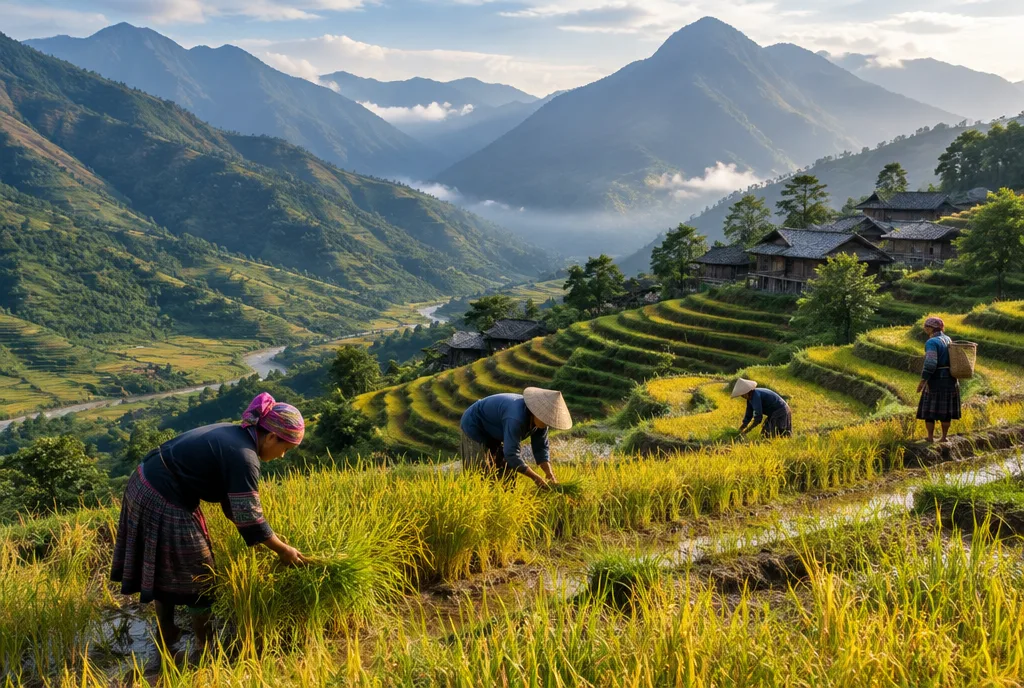
On Bali, rice terraces are irrigated by a network of canals shared by thousands of farmers organized in subaks, cooperative associations that manage water along a stretch of river. The system dates back more than a thousand years and is tied to a hierarchy of water temples, from small shrines at individual weirs to the supreme temple at Lake Batur.
In the 1980s the anthropologist J. Stephen Lansing showed that temple priests coordinated planting schedules across whole watersheds. Synchronized planting and fallow periods deprived rice pests of food, and staggered schedules downstream made sure water was shared fairly. When the government promoted continuous cropping during the Green Revolution, pest outbreaks and water shortages followed. The subak system has been a UNESCO World Heritage Site since 2012.
Andean terraces and the vertical archipelago
In the Andes of Peru and Bolivia, farmland lies at altitudes from under 1,000 to more than 4,000 meters, and climate changes quickly with elevation. The anthropologist and historian John Murra described how Andean communities controlled several ecological zones at once, a pattern he called the vertical archipelago: maize and fruit in warm valleys, potatoes and quinoa higher up, llama and alpaca herds on the high grasslands.
Stone terraces turned steep slopes into flat fields, reduced erosion and created warmer microclimates. Freeze-drying extended the harvest: potatoes left out on frosty nights, trampled to remove water and dried in the sun become chuño, which keeps for years. Storage and exchange between zones buffered communities against crop failure.
Nuer cattle herders of the Nile floodplain
The British anthropologist E. E. Evans-Pritchard studied the Nuer of South Sudan in the 1930s. Their land floods for part of the year and dries into hard, cracked plains for the rest. The Nuer moved with the seasons: in the rains they lived in villages on higher ground, in the dry season they drove cattle to camps near rivers and pools.
Cattle were at the center of Nuer life, providing milk, occasional meat, hides and dung for fires that repelled insects. They also carried social meaning: bridewealth was paid in cattle, disputes were settled with cattle, and men were known by the names of their favorite oxen. Evans-Pritchard’s book The Nuer (1940) showed how ecology, time reckoning and political organization fit together.
The Maya milpa
In Mesoamerica, farmers have long cultivated the milpa, a field in which maize, beans and squash grow together. Beans fix nitrogen in the soil and climb the maize stalks; squash leaves shade the ground and suppress weeds. After several years the field is left to regrow as forest and a new plot is cleared. Many plants in the fallow forest are used for food, medicine and building. Well-managed milpa systems can sustain production for centuries in tropical soils that are poor in nutrients.
What these examples have in common
Across very different environments, the same principles recur:
- Use of local materials and knowledge fitted to a specific climate.
- Rules and rituals that protect key resources from short-term overuse.
- Sharing and cooperation that spread risk across households.
- Strategies that use several environments or seasons instead of one.
- Storage and preservation that bridge periods of scarcity.
These practices are not fixed. When environments, markets or governments change, adaptations that once worked can fail, as the Bali example shows. Cultural ecology studies both the fit and the break.
Frequently Asked Questions
What is a simple example of cultural ecology?
Adobe houses in the American Southwest: thick earthen walls balance hot days and cold nights using locally available material.
Why did Marvin Harris study India’s sacred cows?
To show that a religious taboo can protect animals that provide traction, milk and fuel, and so make ecological sense for small farmers.
What is the subak system?
Bali’s cooperative irrigation system, in which water temples coordinate planting schedules and water sharing among rice farmers.
What is chuño?
Freeze-dried potato made in the high Andes by exposing potatoes to night frost and trampling out the water. It can be stored for years.