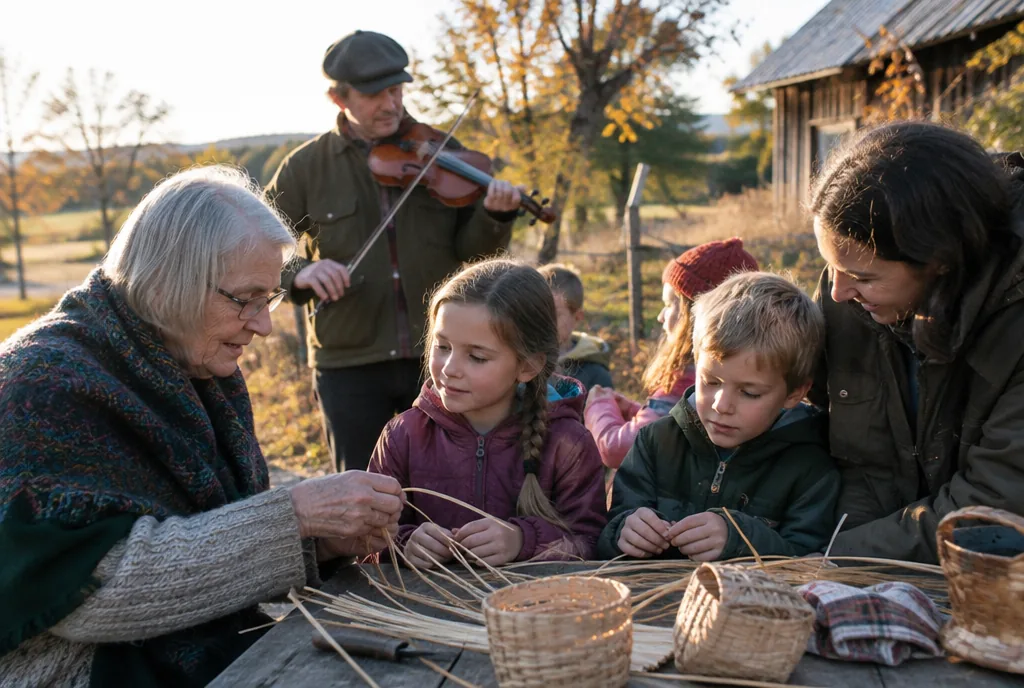
Folk culture is the locally rooted, traditional way of life that a community passes on through personal contact: listening, watching, repeating, and participating. Popular culture travels differently, through mass media and markets. That contrast helps explain why an Amish quilt, a village Maypole dance, and a viral dance trend can all be culture while carrying very different relationships to place, community, and change.
What folk culture means in everyday life
A useful folk culture definition begins with transmission. Folk culture is learned face to face rather than mainly through television, cinema, radio, social media, or streaming. It may include how people speak, prepare food, mark a seasonal event, make clothing, tell a story, or perform music and dance. Such practices are locally anchored and commonly associated with small, relatively homogeneous groups.
In 1947, anthropologist Robert Redfield described the folk society as an ideal type: small, isolated, nonliterate, homogeneous, and marked by strong group solidarity. He placed this ideal type between tribal and urban society. It is not a checklist that every real community must satisfy. It describes a pattern: when a community is closely knit and its knowledge moves largely through direct relationships, traditions can be maintained in forms that differ from village to village.
Local practices have room to develop in relatively isolated settings. A folk culture originates at a local cultural hearth before it diffuses elsewhere. The result is not a museum piece; it can remain active in daily life. Folk traditions can last for generations while still changing as one person teaches another. The key question is not whether a practice is old. Ask how the practice is carried, by whom, and in what local setting.
Folklore shows how culture moves person to person
Folklore makes folk culture visible. On August 22, 1846, British antiquarian William John Thoms first printed the word folklore as an Anglo-Saxon alternative to “popular antiquities.” With that term, scholars gained a compact name for customs and knowledge that had long circulated outside formal institutions.
Folklore is more than fairy tales. It includes four major categories: oral tradition, material culture, customs, and performance. A legend or ballad belongs to oral tradition. Clothing and handicrafts belong to material culture. Customs take shape at festivals and rituals. Performance traditions continue through dance and music. All four may appear at once in the same community, because an annual celebration can involve a story, a costume, a repeated ritual, and a song.
- Oral tradition: tales, legends, ballads, and other material learned by hearing and retelling.
- Material culture: clothing, craftwork, and objects made or used within a tradition.
- Customs: recurring festivals, rituals, and social practices.
- Performance: dance, music, and other traditions enacted before or with others.
For most of human history, literature itself was oral folklore; the separation came only with writing, around 4000 BCE. Much later, the Brothers Grimm’s first 1812 collection of tales encouraged scholars across Europe to record oral literature. Although recording can preserve a version, it does not stop a living tradition from varying in performance. For example, the English ballad “Barbara Allen” has 198 documented versions grouped into three tune families. Here, variation is evidence of transmission, not proof that the tradition failed.
Folk culture examples make the idea concrete
In the United States, the Amish offer a clear example of a living folk culture. They reject modern technology and farm using traditional methods. Their culture is not defined by one object or one belief but by a connected way of life, including community practices and material traditions. Amish quilts from Lancaster County, Pennsylvania, show the material side especially well. Quilts in the “Sunshine and Shadow” pattern, made around 1930, are examples of American folk material culture.
Dance offers a second example. Irish step dance has been preserved as folk culture in rural areas of the Republic of Ireland. That local practice circulates in a different setting than a popularized stage show. Neither form has to be more authentic or more valuable than the other. The question is whether the dance is sustained inside a local tradition or circulated primarily to large, dispersed audiences through staged entertainment.
Once attention shifts from famous works to shared practice, other folk culture examples are easy to recognize. European village Maypole dances are held every year at Beltane or May Day and symbolize the fertility of the earth. Cockney rhyming slang in London’s East End is an oral tradition. Regional foodways such as New England clam chowder, Baltimore crabcakes, and Kansas City barbecue also belong in the picture. Folk culture can be part of an ordinary meal, not only a festival or a tale.
Folk culture vs popular culture: the difference is how culture travels
Popular culture is the set of practices, beliefs, and objects that embody the most widely shared meanings in a social system. Its characteristic channels are television, cinema, radio, social media, and music streaming. After World War II, “popular culture” increasingly overlapped with terms such as mass culture, media culture, and consumer culture. Because distribution is built into the form, a film franchise, a K-pop act, a streaming series, or a TikTok dance can reach huge audiences quickly.
Folk culture typically begins at local hearths in relative isolation. Popular culture is produced in global media centers such as Hollywood, New York, London, Seoul, and Mumbai. The origins of many folk songs are anonymous: the community may not know who first made one. Popular cultural products, by contrast, generally have identified creators and commercial rights holders. These are tendencies, not purity tests. A local practice may be recorded, and a globally distributed work may draw on local traditions.
| Question | Folk culture | Popular culture |
|---|---|---|
| Where does it tend to begin? | At a local cultural hearth, often in relative isolation. | In large media and production centers. |
| How does it spread? | Through oral transmission, imitation, and participation. | Through mass media, markets, and commercial distribution. |
| Who owns it? | Its origins are often anonymous and understood as collective community property. | Creators and commercial rights holders are usually known. |
| How does it change? | Through repeated retelling and performance across generations. | Through rapid media circulation and market-driven trends. |
| What scale does it reach? | Often local or regional. | Often national or global. |
Popular-culture trends may appear and disappear within months, whereas folk culture often remains stable over generations. Even so, folk culture is never simply frozen. “Barbara Allen” makes the point: one ballad survives in 198 documented versions. Continuity lies in the family resemblance among versions and in the social act of passing them on.
A practical way to identify the pattern
Start with the route a practice takes. If people learn it chiefly from relatives, neighbors, or repeated local participation, it has a folk-cultural mode of transmission. Next, look for its setting. When a tradition depends on a specific landscape, seasonal event, local dialect, or community craft, place is doing part of the cultural work. Then consider authorship. Where no single creator or commercial owner is central, collective transmission may matter more than ownership. Finally, follow change over time. In a folk tradition, variation can emerge as people retell or perform it; in popular culture, rapid circulation through media can make a trend visible far beyond its origin.
Place and environment give folk culture its depth
Folk culture is closely tied to the local environment, because communities learn within particular landscapes. A folk tradition can include knowledge of edible plants, hunting techniques, and climate. In subsistence societies, local environmental knowledge directly improves hunting returns and the nutritional quality of community members’ diets. This is cultural ecology in practical form: a community’s practices are connected to the conditions in which it lives.
In environmental anthropology, place attachment is a fundamental idea for understanding this connection. Folk culture grows from long interaction between a community and its local ecosystem. A practice may make sense because of a landscape’s plants, weather, animals, or seasonal rhythms. A tradition is therefore more than an attractive custom: in its environmental setting, it can be useful and meaningful.
Popular culture can be much less place-bound. In New Delhi, a McDonald’s burger tastes almost identical to one in Nairobi. Although that consistency is one strength of a global brand, it contrasts with a local practice that depends on particular knowledge and conditions. The comparison does not mean all global culture is empty or all local culture is environmentally wise. It shows two relationships to place: standardized reproduction across locations versus knowledge shaped through long residence in one place.
Globalization puts local traditions under pressure and into new combinations
Globalization favors popular culture because mass media let cultural products spread quickly and widely. It can suppress folk culture rather than support it, and global fast-food chains have made eating experiences in major cities more alike. In a global study from 2025, three broad outcomes appeared: 40% of countries showed cultural resistance to globalization, 35% showed cultural homogenization, and 25% showed cultural hybridization.
Those categories matter because globalization does not produce a single result. Cultural resistance can take institutional form. In France, law requires quotas for French-language music and films on radio and television, an effort to protect local culture from Anglo-American popular culture. Domestic cinema is another counterweight: worldwide, domestic films account for more than half of box-office revenue in their own countries.
Hybridization is a third outcome beyond loss or preservation. K-pop combines Western pop elements with the Korean language. Korean tacos in the United States and sushi burritos in Europe combine culinary traditions in new forms. Clothing shows a similar process: an Iranian parliamentarian may wear a Western suit without a tie, while Saudi diplomats may move between a Bedouin robe and a business suit. These examples show that cultural contact can produce combinations rather than straightforward replacement.
The pressure on handcraft traditions is real. In the United States, the quilting industry has shrunk from a market volume of $10 billion in 2002 to about $3 billion. A shrinking industry is not identical to the disappearance of every quilting tradition, but it is a reminder that the conditions supporting a craft can change. Folk culture persists through people and practices, not through nostalgia alone.
American folk culture is a living archive, not one national story
American folk culture includes myths, legends, tall tales, oral traditions, music, and customs developed over centuries. Its familiar figures are not all the same kind of story. Frontier figures such as Davy Crockett and Daniel Boone belong to the American tall-tale landscape. Paul Bunyan, the giant lumberjack, is a classic nineteenth-century folklore hero. John Henry, the African American steel driver who competed against a steam-powered drill, is one of the best-known American folk legends.
Pecos Bill, the cowboy who rode a tornado, and Johnny Appleseed also belong to the American folklore canon. These characters make memorable examples because they compress labor, landscape, travel, and exaggeration into stories that could circulate orally. Their importance is not that every detail is factual history. Folklore is a record of what communities tell, perform, and recognize together.
Material culture belongs in that archive too. The Smithsonian American Art Museum holds the largest Amish-quilt collection of any art museum. Its 2024 exhibition “Pattern and Paradox” included 50 objects. A “Sunshine and Shadow” quilt may be interpreted as a symbol of balance between good and evil, but there is no evidence that the Amish themselves share that specific interpretation. That uncertainty is worth retaining: a museum interpretation and a community’s own meaning are not automatically the same thing.
High culture, folk culture, and popular culture can cross boundaries
High culture commonly refers to forms valued by social elites, including classical music, opera, ballet, fine art, and demanding literature. It is often sustained by institutions such as opera houses, museums, and orchestras, while popular culture is more directly organized through the market. In Distinction (1979), French sociologist Pierre Bourdieu argued that high culture can serve social distinction and is associated with educational and economic capital.
These categories are not sealed compartments. In the nineteenth century, Brahms, Dvořák, and Canteloube adapted folk music into art music with piano accompaniment. The movement also goes in the other direction: Schubert songs such as “Heidenröslein” and arias from Mozart’s The Magic Flute entered folk tradition. Folk culture and high culture can therefore influence one another without becoming identical.
Common myths hide what folk culture actually does
Myth: Folk culture never changes
Folk culture can resist rapid change and remain recognizable over generations, but oral transmission also produces variation. The 198 versions of “Barbara Allen” demonstrate that a tradition can change in performance while retaining relationships among versions.
Myth: Folk culture is only ancient storytelling
Stories matter, but folklore also includes material culture, customs, and performance. A quilt, a regional dish, a May Day dance, and a local dialect can all belong to folk culture.
Myth: Local means inferior to high culture or popular culture
“Local,” “elite,” and “mass-mediated” describe different cultural positions and systems of circulation. They are not a ranking of human worth. The same folk music can become art music, and an art song can enter folk tradition.
Myth: Globalization simply destroys local culture
Homogenization is one documented outcome, but resistance and hybridization are others. French media quotas, strong domestic film markets, K-pop, and new hybrid foods show that local and global forces can conflict, persist, and combine.
Frequently Asked Questions
What is folk culture?
Folk culture is a locally rooted, traditional way of life passed on primarily through oral communication, imitation, and shared participation rather than through mass media. It can include stories, crafts, customs, foodways, music, dance, and local knowledge.
Can you give me an example of a folk culture?
The Amish in the United States are a living example. They reject modern technology and farm with traditional methods; their quilts also represent a form of material folk culture.
What is American folk culture?
American folk culture includes the myths, legends, tall tales, oral traditions, music, and customs that have developed in the United States. Paul Bunyan, John Henry, Pecos Bill, Johnny Appleseed, Davy Crockett, and Daniel Boone are well-known figures in that folklore.
What are five examples of folklore?
Five examples are a ballad such as “Barbara Allen,” an Amish quilt, a Maypole dance, Cockney rhyming slang, and a regional foodway such as Kansas City barbecue. Together they represent oral tradition, material culture, custom, performance, and food tradition.
How is popular culture different from folk culture?
Popular culture spreads widely through mass media, including television, cinema, radio, social media, and streaming. Folk culture is carried more directly between people and is often tied to a local community and environment.