Environmental determinism is the claim that physical surroundings set societies on particular economic, social, and cultural paths. In practice, climate, terrain, soil, water, disease environments, and resources plainly matter. The harder question is whether they dictate what people become, or whether people work within limits through institutions, collective action, and cultural choices. At the center of the debate is the divide between environmental determinism and possibilism.
Environmental Determinism Defines Environment as Destiny
In its strongest form, environmental determinism says that the physical environment determines the development of a society or state. It is also called climatic determinism or geographical determinism. Instead of treating geography as one influence among many, the theory gives it decisive explanatory power: a hot climate, a mountain range, a particular soil, or a disease setting is presumed to produce a corresponding kind of culture or economy.
In AP Human Geography, students often meet this version first. The approach holds that climate, terrain, soil, and resources shape and constrain culture so strongly that the environment essentially dictates what people can do. On a map, it provides a quick way to connect a physical pattern to a human one. Its weakness is equally clear: a quick connection can turn a complex history into a one-cause story.
Environmental influences are real. Transport costs affect market access. Disease environments can slow economic development. Agricultural productivity shapes the material conditions in which people make decisions. None of those points proves that geography fixes a culture’s future. The disagreement begins when influence is mistaken for inevitability.
Geography Influences Development Through Concrete Pathways
Geography influences development through conditions that can make some activities easier, harder, cheaper, or riskier. A location’s access to markets affects the movement of goods. A difficult disease environment places a burden on workers and households. Climate, soil, and available resources affect what farmers can grow. These are mechanisms, not a verdict on the intelligence, worth, or potential of the people living in a place.
Research associated with Sachs and Gallup emphasizes transport costs, market access, disease environments, and agricultural productivity as direct influences on development. In other arguments, factor endowments such as land, climate, and labor connect to institutional patterns such as plantation agriculture or small farming. That is a more cautious claim than saying nature alone creates a society: physical conditions may help shape a development path without making every later outcome unavoidable.
The institutional challenge is important. In 2001, Acemoglu, Johnson, and Robinson reported that former colonies that had been relatively rich in 1500 were relatively poor later, a reversal that does not fit a purely geographic account. In related work, they found that, after controlling for institutional quality, distance from the equator and an Africa variable were not significant. In reply, Sachs and John McArthur said that institutional and geographic variables, including malaria incidence and life expectancy, were both strongly correlated with GDP per person. The debate therefore asks how factors work together, not whether maps should be ignored.
Possibilism Starts with Limits but Centers Human Choices
The simple definition of possibilism is that the environment sets limits and offers opportunities, while social conditions largely shape what a culture does within them. Where determinism asks what the environment forces people to do, possibilism asks what possibilities it offers and which people choose.
This does not mean that human choice is unlimited. Alfred L. Kroeber’s criticism makes the distinction vivid: the Arctic constrains agriculture, but that constraint does not explain why a particular cultural practice began or why a particular society organized itself as it did. Possibilism keeps the boundary in view while refusing to treat the boundary as a complete explanation.
| Question | Environmental determinism | Possibilism |
|---|---|---|
| What does environment do? | It determines the main course of culture and development. | It sets limits and presents options. |
| What explains different outcomes? | Climate and geography carry most explanatory weight. | Social conditions shape choices within environmental limits. |
| How is human agency treated? | It is secondary to physical conditions. | It is central, though never unconstrained. |
| What is the main risk? | Turning correlation into destiny. | Understating a hard material limit. |
The idea is older than its modern label. The Greek geographer Strabo warned against assuming that physical surroundings alone determine human action; he saw people as active partners in the human-environment relationship. Much later, Paul Vidal de La Blache became the intellectual father of possibilism, although he did not use the term himself. In his genre de vie, or way of life, communities develop distinctive ways of living through active engagement with their surroundings. In 1925, Lucien Febvre popularized the term possibilism.
Cultural Ecology Shows How Environment and Society Interact
Between the two positions, cultural ecology offers a productive middle path. In 1955, Julian Steward developed this approach to study how cultural change is induced through adaptation to the environment. His point was not that every society follows one environmental script. Instead, an explanation should examine the practical relationship between a group’s surroundings, its technology, and its ways of making a living.
Steward called the features most closely tied to subsistence and economy the cultural core. Beyond that core, other features can be more strongly shaped by diffusion and chance. This distinction helps avoid a common error: assuming that every feature of a society follows directly from climate or terrain.
- Analyze the relationship between technology and the environment.
- Analyze behavior involved in using resources.
- Analyze how those patterns affect other areas of culture.
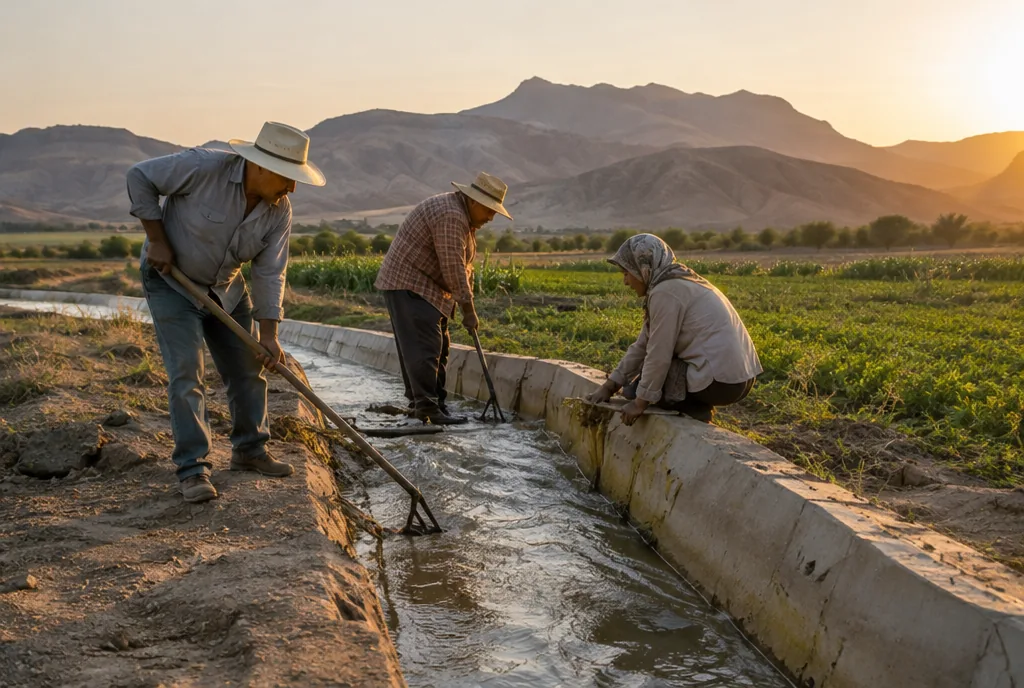
Steward used irrigation civilizations in arid climates to show a possible sequence: collective labor and centralized authority could lead to growing social stratification and eventually to state formation. The point was multilinear evolution, not a universal law that every dry region must produce the same political order. In this view, environment creates a problem and an opportunity; a society’s response depends at least as much on its sociocultural conditions.
The History Explains Why the Theory Became So Influential
Arguments linking place and people are ancient. Around 400 BCE, Hippocrates wrote in On Airs, Waters, and Places about how climate, winds, and water quality could shape bodies, behavior, and susceptibility to illness. Aristotle divided the world into temperate, hot, and cold zones and attached judgments about civilization to those zones. In China, philosopher Guan Zhong likewise wrote that soil and water conditions form people’s character.
In 1748, Montesquieu systematized climatic determinism in The Spirit of the Laws, arguing that laws should be adapted to climate and geographic circumstances. In the nineteenth century, Carl Ritter emphasized the influence of the Earth’s surface on human history. With the two volumes of Anthropogeographie in 1882 and 1891, Friedrich Ratzel then supplied a major theoretical foundation for environmental determinism.
For the “father” question in environmental determinism, Ratzel is the figure commonly associated with the answer, although he is specifically known as the father of political geography. He also coined Lebensraum. In 1897, his Political Geography introduced social-Darwinist concepts, and Rudolf Kjellén later interpreted Lebensraum aggressively in ways that influenced Nazi ideology. That history is a reason to handle simple environmental explanations with care.
In the United States, Ellen Churchill Semple was the leading representative of environmental determinism and the first president of the Association of American Geographers. Her 683-page 1911 book Influences of Geographic Environment brought Ratzel’s difficult Anthropogeographie to English-language readers. In a Philippine example, she mapped lowlands as civilized and highlands as uncivilized. Yet Semple deliberately used “geographic factors and influences,” rather than “geographic determinant,” a revealing detail in a work often remembered as wholly deterministic.
Why Scholars Rejected One-Cause Explanations
Because it reduces many possible causes to one, environmental determinism was widely rejected in human geography and anthropology. In the 1920s, Lucien Febvre attacked the approach, arguing that social factors usually outweigh natural influences. Subsequently, possibilism became the standard perspective in human geography, and it remains dominant in anthropology despite its own limits.
The political stakes were also severe. By claiming that temperate-zone peoples were naturally superior, racist and colonial narratives gained an apparently scientific foundation and support for imperialism. Describing a community as the automatic product of a tropical climate, a mountain setting, or a resource base can erase its history, institutions, and decisions while making unequal power look natural.
When they become monocausal, modern environmental arguments can revive this problem. In 1997, Jared Diamond’s Guns, Germs, and Steel argued that continental east-west axes and the availability of domesticable species shaped global power relations over 13,000 years. James Morris Blaut criticized the work as a revival of environmental determinism, and Andrew Sluyter later used the term “neo-environmental determinism” for this kind of account. The criticism is not that environment is irrelevant; it is that a single environmental story can become too neat for the evidence it tries to explain.
Common Myths Hide the Real Debate
Myth: Rejecting determinism means geography does not matter
Geography matters through disease environments, market access, transport costs, resources, and agricultural possibilities. Rejecting determinism means refusing to make those conditions the sole cause of culture or development.
Myth: Possibilism says people can overcome any environmental limit
Possibilism begins with constraints. It says that culture and social conditions shape responses within those constraints; it does not say that every option is available everywhere.
Myth: Climate explains why places are rich or poor
Climate can be part of an explanation. The climatic-determinist argument known as the equatorial paradox holds that tropical countries face structural disadvantages from heat, malaria, and lower agricultural productivity. Yet institutional research and the continuing disagreement over geography show why climate alone cannot settle the question.
Myth: Similar environments produce identical societies
Cultural ecology points in a different direction. The same type of environmental challenge can meet different technologies, resource-use practices, and social arrangements, and those differences can lead to different cultural outcomes.
Frequently Asked Questions
What is environmental determinism in AP Human Geography?
In AP Human Geography, environmental determinism is the theory that the natural environment shapes and creates cultures. In this account, climate, terrain, soil, and resources are treated as factors that dictate what people can do and how societies develop.
What is the simple definition of possibilism?
Possibilism is the view that the environment sets limits and provides options, while social conditions and cultural choices shape the response. In place of environmental destiny, it offers constrained choice.
Who is the father of environmental determinism?
Friedrich Ratzel is commonly named, because his Anthropogeographie provided a major theoretical foundation for the approach. He is also known as the father of political geography. Ellen Churchill Semple became the most important American representative of environmental determinism.
How does geography influence development?
Geography can influence development through transport costs, market access, disease environments, and agricultural productivity. These factors interact with institutions rather than acting as a complete explanation on their own.
Is climate destiny?
No. Climate can create pressures and opportunities, but cultural ecology and possibilism show why social organization and human responses also belong in the explanation.