A cultural hearth is a geographic area where new cultural ideas and innovations emerge, take root, and spread outward. The phrase makes a useful image: like a hearth around which people gather, such a place becomes a center for sharing knowledge and organizing everyday life. Some hearths are associated with ancient cities, farming, writing, and states; others are modern cities whose cultural exports travel far beyond their boundaries. The important question is not simply where something began, but how a particular environment and its people made innovation possible.
Cultural hearth definition: a place where ideas take hold and travel
Within cultural geography, a cultural hearth is an origin area for cultural practices, technologies, or institutions that later diffuse into other places. The geographer Carl Sauer used the term for the regions where agriculture originated. Domestication changes more than the food supply: it can alter land use, settlement, work, exchange, and social organization at the same time.
Early cultural hearths are often called cradles of civilization, because the first complex societies with agriculture, cities, writing, and state organization developed there. Yet a hearth is not just a list of inventions or a dot on a map. It is a region shaped by geographic, social, and historical conditions that together support new practices and their movement across space.
The word hearth comes from the idea of a fire around which people gather and exchange ideas. That image also prevents a common mistake. A hearth is not one person’s discovery or one isolated city. It is a setting in which many people, resources, skills, and connections can produce changes that endure.
Why water, food, and human choices made hearths possible
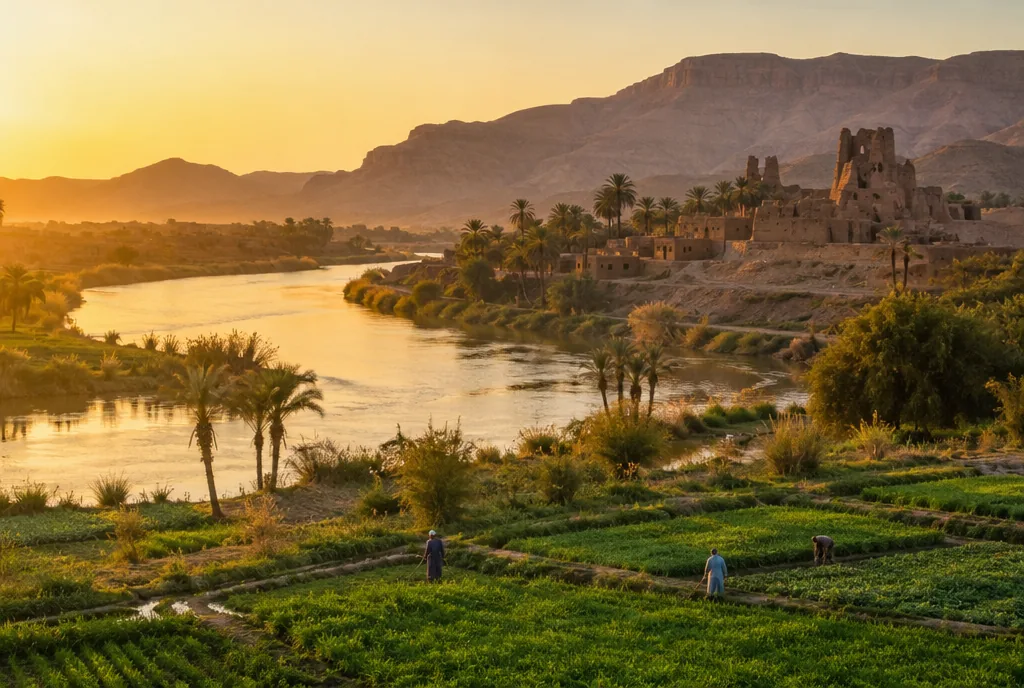
Across early cultural hearths, water was a recurring advantage. Along the Tigris and Euphrates, Nile, Indus, Huang He, Ganges, and Niger, major river systems brought access to water and fertile floodplains. The resulting food surpluses supported the growth of empires. Rivers did not create civilizations on their own, however. Communities had to manage them with canals, dikes, and terraces before durable urban settlements could take hold.
Equally important were local plants and animals. In the Fertile Crescent, wild emmer, einkorn wheat, and barley grew alongside wild sheep, goats, pigs, and cattle. That combination gave people a strong set of plants and animals to domesticate. In northern China, semiarid conditions favored drought-resistant broomcorn millet. Across Mesoamerica, maize, beans, and squash formed a productive mixed-cropping system: beans add nitrogen to the soil, while squash shades the ground and suppresses weeds.
Environmental opportunity is only half the story. People turned those opportunities into settlements through irrigation, storage, farming systems, buildings, exchange networks, and ways to coordinate large communities. Around 1900 BCE, a weakening Indian summer monsoon contributed to the decline of the Indus civilization, a reminder that a favorable setting can change. A cultural hearth is therefore best understood as an interaction between ecology and human action, not as an environmental guarantee.
The five cultural hearths in AP Human Geography
In AP Human Geography, five core cultural hearths are commonly used as a classroom framework: Mesopotamia, the Nile Valley, the Indus Valley, the Huang He Valley, and Mesoamerica. This framework helps compare major regions of early complex society. It should not be treated as a ranking of importance or as a complete list of every place where cultural innovation occurred.
| Core hearth | Region or river setting | Concrete example from the record |
|---|---|---|
| Mesopotamia | Between the Tigris and Euphrates | Urbanization began around 5000 BCE; cuneiform emerged in Sumer around 3400–3200 BCE. |
| Nile Valley | Egypt and the Nile | Annual floods left fertile silt; the dynastic period began with the unification of Upper and Lower Egypt around 3100 BCE. |
| Indus Valley | Harappan civilization | From about 2600–1900 BCE, more than 1,500 settlements occupied an area of roughly 680,000–800,000 square kilometers. |
| Huang He Valley | Yellow River in northern China | The Yangshao culture dates to about 5000–3000 BCE, followed by the Longshan culture about 3000–1900 BCE. |
| Mesoamerica | Mexico and Central America | Maize was domesticated from wild teosinte in the Balsas Valley of central Mexico about 9,000 years ago. |
A broader classical list names eight ancient hearths: West Africa, the Nile Valley, Mesopotamia, the Indus Valley, the Ganges Delta, the Huang He Valley, Mesoamerica, and the Andes region of Peru. The difference between five and eight is not a contradiction in the past. It reflects different teaching frameworks and definitions of which early centers to include.
Mesopotamia shows how a river landscape can become a cultural hearth
Mesopotamia, the “land between the rivers,” lay between the Euphrates and Tigris in what is now Iraq and Syria. It is one of the world’s best-known cultural hearth examples because its history connects food production, irrigation, cities, writing, technology, and law. Rain was not sufficient for agriculture, so fields were irrigated through canals fed by the two rivers. That engineering made cultivation possible on a large scale.
The wider Fertile Crescent contains some of the earliest evidence of settled life: Jericho was inhabited by about 10,000 BCE, and Neolithic pottery in Mesopotamia dates to before 7000 BCE. Urbanization in Mesopotamia began around 5000 BCE. By around 3400 BCE, Uruk had an estimated population of 40,000 to 80,000 people and is described as the first large city in the world.
Several developments show why Mesopotamia is more than a place-name in a textbook. The Sumerians developed the wheel and the plow around 3500 BCE, changing transport and agriculture. Cuneiform emerged in Sumer around 3400–3200 BCE and is regarded as the earliest known writing system. During the Bronze Age, the region was home to the Sumerians, Akkadians, Babylonians, and Assyrians.
Later, the Code of Hammurabi made legal rules visible in material form. Dating to about 1754 BCE, the collection contains 282 provisions in cuneiform on a 2.25-meter diorite stele. Taken together, canals, cities, records, tools, and laws illustrate what the cultural hearth concept captures: connected changes in how people used land, organized life, and transmitted knowledge.
The Indus Valley reveals a different pattern of urban coordination
The Indus Valley civilization, also called the Harappan civilization, flourished from about 2600 to 1900 BCE. Its more than 1,500 settlements covered roughly 680,000 to 800,000 square kilometers. The scale alone makes the Indus Valley essential to any account of ancient civilizations, but its infrastructure gives the hearth particular clarity.
Mohenjo-Daro had more than 700 wells, and most houses had their own private well. Its Great Bath measured about 12 by 7 meters and was at most 2.4 meters deep. Builders made its floor waterproof with closely laid bricks, gypsum plaster, and a thick layer of bitumen. Those details show a sustained capacity to work with water, standardized materials, and shared built spaces.
Standardization appears in other parts of Indus life. Bricks followed a 1:2:4 proportion, a basic pattern repeated across thousands of buildings. Cubic stone weights ranged from 0.05 to 500 grams and followed a standardized system. The Indus script appears on more than 4,000 seals, though it has not been fully deciphered; the “unicorn” is the most frequent seal image.
The Indus world also traded with Mesopotamia. Carnelian beads, shell bracelets, and lapis lazuli moved through these connections, while Indus seals found at Ur and Sumerian texts referring to “Meluhha” point to the relationship. At the same time, the Indus weight system developed independently of the Mesopotamian system. A cultural hearth can therefore be connected to other regions without being a copy of them.
Other hearths expand the map beyond the familiar five
Looking beyond the AP framework gives a fuller view of human innovation. In West Africa’s Niger River region, ironworking and the cultivation of sorghum and millet supported complex societies including Ghana, Mali, and Songhai. The Ganges Delta is counted as a distinct hearth because of early urban settlements, the development of Hindu traditions, and the domestication of rice and buffalo.
In the Andes region of Peru and Bolivia, people independently domesticated potatoes, quinoa, llamas, and alpacas. Early irrigation systems and monumental architecture were part of this landscape; Caral dates to about 2600 BCE. These examples matter because they prevent the word “hearth” from becoming shorthand for only a few famous river valleys.
The Nile, Huang He, and Mesoamerica add different measures of complexity
Egypt’s Nile Valley shows how a seasonal river could structure both farming and time. From June through October, the Nile flooded its valley and left alluvial silt that made the soil exceptionally fertile. Egyptians organized the year into Akhet, the flood season; Peret, the sowing and growing season; and Shemu, the harvest and low-water season. Each had four months of 30 days, followed by five extra days. Grain surpluses could be stored or traded, providing the agricultural base for the kingdom.
The scale of Egypt’s monumental building gives another concrete marker of organized labor. The Great Pyramid of Giza, built around 2560 BCE, used more than 2.3 million stone blocks with an average weight of 2.5 tons. Hieroglyphic writing emerged around 3200 BCE. The Narmer Palette, made around 3100 BCE, contains some of the earliest known hieroglyphs.
The Huang He Valley offers another environmental contrast. At Cishan, evidence from storage pits shows about 50,000 kilograms of millet in storage. Broomcorn millet was especially suited to the semiarid conditions of northern China; it is more drought resistant than foxtail millet. Much later, the Shang dynasty, about 1600–1046 BCE, left oracle bones with the oldest surviving Chinese characters, more than 4,000 of them.
Mesoamerica developed its own distinctive cultural systems. The Olmec culture on Mexico’s Gulf Coast, dating to about 1200–400 BCE, is known for basalt colossal heads as high as 3 meters and weighing up to 50 tons. Teotihuacan covered about 20 square kilometers around 400 CE and had an estimated population of 125,000 to 200,000. Its planned grid, monumental public spaces, and housing compounds show another way a cultural landscape could organize urban life.
Mesoamerican development also included intellectual systems, not only agriculture and cities. Maya scholars developed a base-20 number system that included zero around 36 BCE, the first documented use of zero in the Americas. The Olmec were using cacao beans around 1000 BCE, and the Maya drank chocolate as a bitter beverage by at least 600 BCE. These details show why a culture hearth cannot be reduced to one crop, one river, or one kind of achievement.
Common myths make cultural hearths harder to understand
Myth: A hearth is one city where everything began
A cultural hearth is a geographic area, not a single building or a single moment. Mesopotamia includes a river landscape, irrigation, multiple cities, and several societies over long periods. The same regional perspective helps explain the Indus Valley, the Nile Valley, and other hearths.
Myth: The five cultural hearths are the only ones
The five are a useful AP Human Geography framework, but a broader classical list includes West Africa, the Ganges Delta, and the Andes. The framework is an organizing tool, not a claim that innovation happened nowhere else.
Myth: Geography alone produces a hearth
Fertile soil or a river creates possibilities, not finished cultures. Canals, dikes, terraces, crop choices, storage, and exchange were human responses to local conditions. In Mesoamerica, for example, farmers used shifting cultivation because maize depleted tropical soils after about five years.
Myth: Cultural hearths belong only to the ancient world
Modern cultural hearths can be cities that produce large amounts of cultural exports. New York City, Los Angeles, and London are examples. The scale and media differ from ancient river valleys, but the central idea remains: cultural practices emerge in a place and spread outward.
Frequently Asked Questions
What is a cultural hearth?
A cultural hearth is a geographic area where cultural ideas and innovations arise and then spread to other regions. Its development reflects a combination of geographic, social, and historical factors.
What are the five cultural hearths?
The five core cultural hearths commonly used in AP Human Geography are Mesopotamia, the Nile Valley, the Indus Valley, the Huang He Valley, and Mesoamerica.
Can you give an example of a cultural hearth?
Mesopotamia is a clear example. Between the Tigris and Euphrates, canal irrigation supported agriculture, while cities such as Uruk, cuneiform writing, the wheel, and the plow emerged in the region.
What is the cultural hearth of Buddhism?
The cultural hearth of Buddhism is the region of present-day Nepal and northeastern India, especially Lumbini and the kingdom of Magadha in what is now Bihar. Siddhartha Gautama was born in Lumbini around the fifth century BCE, and Buddhism later spread along Silk Roads and trade routes into East Asia.
Is a culture hearth the same as a cultural hearth?
Yes. Culture hearth is commonly used as a shorter form of cultural hearth. Both refer to an origin area from which cultural practices and innovations diffuse.
Why do rivers appear so often in cultural hearth examples?
Major rivers provided water and fertile floodplains that could support food surpluses. River systems alone did not create cities; people also built irrigation works and other systems to manage resources.