Ecology is the scientific study of how organisms interact with each other and with their physical surroundings. The German zoologist Ernst Haeckel coined the word in 1866 from the Greek oikos, meaning household. Since then the field has split into several branches that ask different questions at different scales, from the behavior of a single animal to the carbon cycle of the whole planet. This overview introduces the main topics and the classic studies behind them.
Levels of organization
Ecologists usually sort their work by scale. Each level has its own questions and methods:
- Organism: how an individual copes with heat, cold, drought or salt, and how it finds food and mates.
- Population: all individuals of one species in an area, and how their numbers change.
- Community: all species living together in one place and how they interact.
- Ecosystem: the community plus its physical environment, with flows of energy, water and nutrients.
- Landscape: patterns of forests, fields, rivers and towns across a region.
- Biosphere: the global system of life, atmosphere, oceans and soils.
The levels are connected. A drought that stresses individual trees can reduce a population, change which species dominate a community and alter the water balance of an entire watershed.
Behavioral ecology
Behavioral ecology asks why animals behave the way they do in a given environment. Typical questions concern foraging (which food to pursue and when to move on), territoriality (when it pays to defend an area), mating systems and cooperation.
A classic contrast is social life. Gray wolves hunt in packs that are usually built around a breeding pair and their offspring, which lets them bring down elk or moose far larger than a single wolf. Tigers, by contrast, hunt alone in dense forest, where stealth matters more than numbers, and they defend large individual territories. Both strategies fit the prey and the habitat in which they evolved.
Optimal foraging theory, developed from the 1960s onward, predicts that animals choose food and feeding sites in ways that maximize energy gained per unit of time. Field studies of birds, bees and even human foragers have tested and refined these predictions.
Population ecology
Population ecology studies how and why numbers of a species rise and fall. A population with abundant resources can grow exponentially, but growth slows as it approaches the carrying capacity of its environment, the number of individuals the habitat can support over time. The resulting S-shaped curve is called logistic growth.
The most famous data set in population ecology comes from the fur trade. Records of lynx and snowshoe hare pelts bought by the Hudson’s Bay Company in Canada show regular cycles of about ten years over more than a century. Hare numbers rise, lynx numbers follow, hares crash, and lynx crash in turn. Later field experiments in the Yukon showed that the hare cycle depends on both predation and food supply.
Population ecology has direct practical uses: setting fishing quotas, managing hunting seasons, controlling pests and planning the recovery of endangered species.
Community ecology
Community ecology looks at how species living together affect each other through competition, predation, parasitism and mutual help. A central question is why so many species can coexist instead of one outcompeting the rest.
Keystone species
In the 1960s the ecologist Robert Paine removed the predatory ochre sea star, Pisaster ochraceus, from stretches of rocky shore in Washington State. Without the sea star, mussels took over the rocks and the number of species in the plots fell sharply. Paine called such species keystone species: their effect on the community is far larger than their abundance would suggest.
A later example is the reintroduction of gray wolves to Yellowstone National Park in 1995. Wolves reduced and redistributed elk herds, which changed grazing pressure on willows and aspens along some streams. The strength of these cascading effects is still debated among researchers, but the case has become a textbook example of how predators can shape ecosystems.
Ecosystem ecology
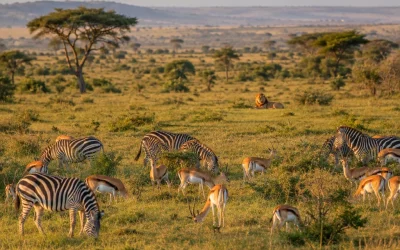
Ecosystem ecology follows energy and materials through living systems. Plants capture solar energy through photosynthesis; herbivores eat plants; carnivores eat herbivores. At each step most of the energy is lost as heat, so on average only about ten percent passes from one trophic level to the next. That is why food chains rarely have more than four or five links, and why there are far fewer lions than zebras.
Nutrients, unlike energy, cycle. Carbon, nitrogen, phosphorus and water move between organisms, soils, oceans and the atmosphere. Research on these cycles underpins much of today’s climate science, for example measurements of how much carbon forests, grasslands and oceans absorb each year.
Human ecology and applied topics
Humans are now the dominant ecological force on the planet, and several branches of ecology focus on human impact:
- Land use change: conversion of forests and grasslands to farms and cities is the main driver of habitat loss.
- Overexploitation: the collapse of the northern cod off Newfoundland led Canada to declare a fishing moratorium in 1992, ending a fishery that had lasted nearly five centuries.
- Pollution: pesticides, excess fertilizer and plastics alter ecosystems far from their source.
- Invasive species: animals and plants moved by people can displace native species.
- Urban ecology: cities form ecosystems of their own, with specific species, heat islands and water flows.
Closely related is cultural ecology, which studies how human societies adapt to their environments through technology, social organization and belief. It forms the main subject of this site.
How ecologists work
Ecology combines three kinds of evidence. Field observation records what happens in nature, from bird counts to tree rings. Experiments manipulate one factor, as Paine did by removing sea stars or as researchers do by fencing out grazers or adding fertilizer to test plots. Models, from simple equations of population growth to global climate and vegetation simulations, connect the observations and make predictions. Long-term monitoring sites such as the US Long Term Ecological Research network provide the decades of data needed to see slow changes.
Types of ecosystems
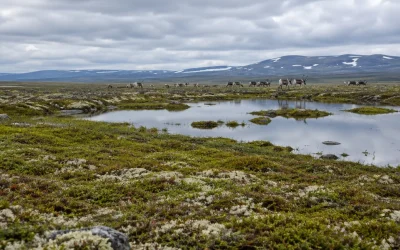
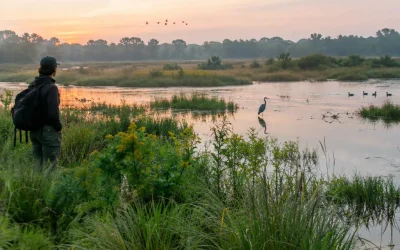
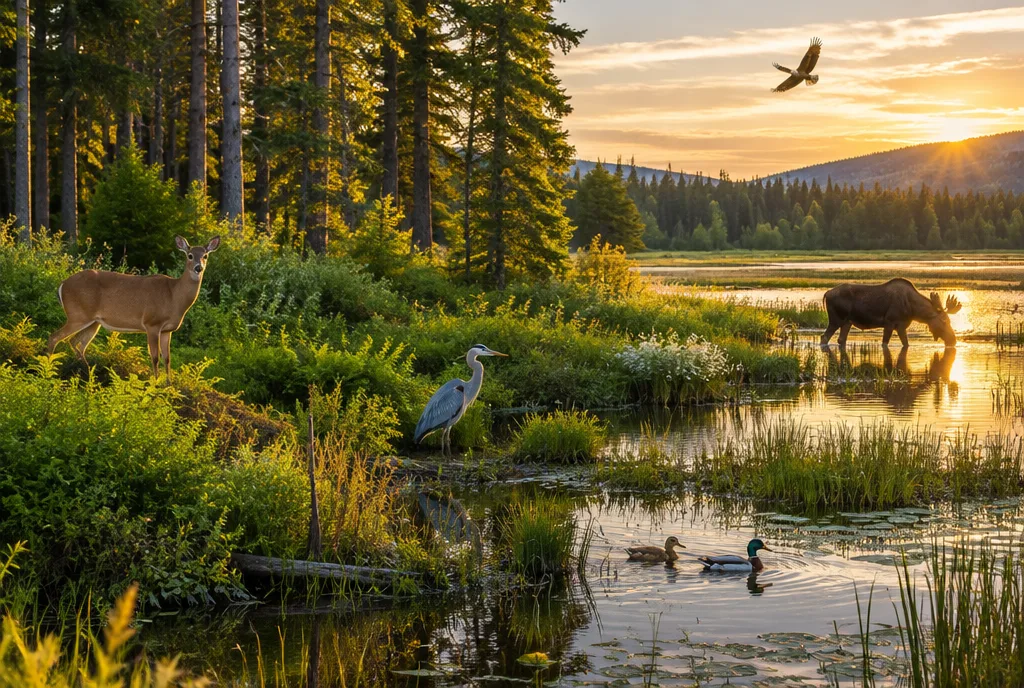
Ecosystems are commonly grouped into terrestrial systems such as forests, grasslands, deserts and tundra; freshwater systems such as lakes, rivers and wetlands; and marine systems such as coral reefs, kelp forests and the open ocean. Each has characteristic species, climate and nutrient dynamics. Many of the most productive areas lie at boundaries, such as estuaries and floodplains, where land and water meet.
Frequently Asked Questions
Who coined the term ecology?
The German biologist Ernst Haeckel, in 1866.
What is a keystone species?
A species whose effect on its community is much larger than its numbers suggest. The ochre sea star studied by Robert Paine is the classic example.
What is carrying capacity?
The largest population of a species that an environment can support over time with its available food, water and space.
Why do food chains have so few links?
Only about ten percent of energy passes from one trophic level to the next, so there is too little energy left to support many levels of predators.