Cultural ecology is the study of how human societies adapt to their environments and how, in turn, they transform those environments. It looks at the links between climate, soils, water and wildlife on one side and technology, work, family organization and belief on the other. The field took shape in American anthropology in the 1950s and has since influenced archaeology, geography and environmental studies. This overview explains its origins, key concepts, famous case studies and related disciplines.
Definition
A common short definition is the study of the processes by which a society adapts to its environment. Adaptation here is meant broadly. It includes the tools and techniques people use to obtain food and shelter, the size and mobility of their groups, the rules that govern access to land and water, and the ideas and rituals that guide how resources are used.
Cultural ecology does not assume that environment determines culture. Similar environments have supported very different ways of life, and people continuously reshape their surroundings through farming, herding, fire, irrigation and building. The field studies the interaction in both directions.
Origins
Several strands came together before the field had a name:
- Franz Boas, whose first fieldwork among the Inuit of Baffin Island in 1883–84 examined how sea ice and seal movements influenced settlement, but who rejected any simple environmental explanation of culture. His approach is described in the article on historical particularism.
- Alfred Kroeber, a student of Boas, who mapped culture areas of Native North America and related them to natural regions.
- Carl Sauer, a geographer at Berkeley, who studied how cultures create landscapes through agriculture and fire.
The anthropologist Julian Steward, trained at Berkeley, drew these strands together. In Theory of Culture Change (1955) he named the field and gave it a method: analyze the environment and technology of a society, study how people organize work to exploit it, and determine how these patterns affect the rest of culture. A shorter summary is available in cultural ecology theory in brief, and the development of the subfield is traced in cultural ecology anthropology.
Core concepts
Culture core
Steward’s term for the features of a culture most closely connected with subsistence: division of labor, group size, settlement pattern and property rules. He expected these to show regular relationships with the environment across societies.
Adaptation
Adaptation refers to practices and institutions that allow a population to persist in its environment. Examples range from architecture suited to heat or cold to sharing rules that buffer families against bad hunting seasons. A collection of such cases can be found in examples of cultural ecology.
Carrying capacity
Borrowed from biology, carrying capacity is the number of people an environment can support with a given technology. Cultural ecologists stress that it is not fixed: irrigation, new crops or trade can raise it, while soil erosion or climate change can lower it.
Multilinear evolution
Instead of a single ladder of progress, Steward proposed that societies follow several paths, with similar paths in similar environments. Irrigation societies in Mesopotamia, Egypt, China and Peru, for instance, developed some comparable political institutions.
Cultural ecology in archaeology
Archaeologists adopted cultural ecology quickly, because the material remains they study, such as tools, houses, fields and food waste, record subsistence more directly than beliefs.
Gordon Willey’s survey of the Virú Valley on the north coast of Peru, published in 1953, was one of the first settlement pattern studies. Instead of excavating a single site, Willey mapped hundreds of sites across the valley to reconstruct how settlement, irrigation and political organization changed over time. The approach became standard in regional archaeology.
In the 1960s Lewis Binford and others launched the New Archaeology, later called processual archaeology. It treated culture as a system of adaptation to the environment and used scientific methods, including animal bones, plant remains, pollen and soil analysis, to test hypotheses about how past societies lived.
Famous cases
Norse and Inuit in Greenland
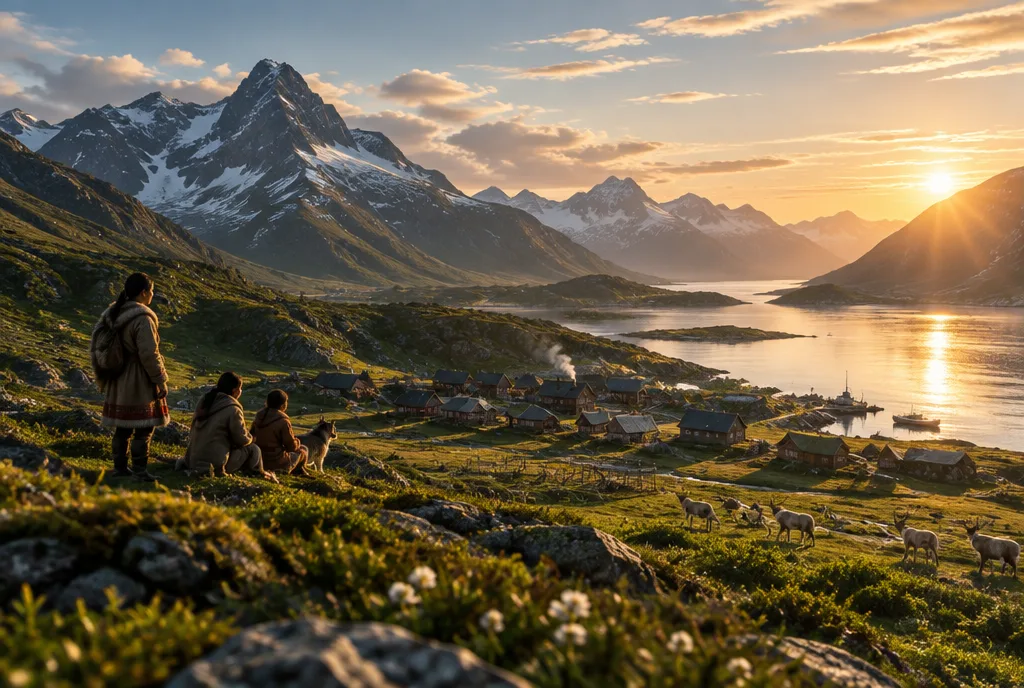
Norse settlers from Iceland established farming colonies in southwestern Greenland from around 985. They kept cattle, sheep and goats, built churches and traded walrus ivory with Europe. By the fifteenth century the settlements had been abandoned. The Inuit, who arrived in the same period, survived. Researchers point to several factors: a cooling climate, declining ivory trade, isolation from Europe and the Norse emphasis on livestock farming. Later studies show the Norse did adapt in part, eating more seal over time, but not enough to overcome the combined pressures.
The Classic Maya
Between about 800 and 950, many Classic Maya cities in the southern lowlands of Mexico, Guatemala and Belize were abandoned. Sediment cores from lakes indicate a series of severe droughts in this period. Most researchers now see the collapse as the result of drought combined with population pressure, deforestation, warfare between city-states and a loss of faith in rulers. Maya populations persisted in other regions, and millions of Maya live in the area today.
Easter Island
Rapa Nui (Easter Island) was once widely presented as a case of self-inflicted ecological collapse: islanders cut down the palm forest to move their famous statues, and society fell apart. Newer research questions this account. It emphasizes the role of introduced rats in preventing palm regeneration, finds evidence that the population remained relatively stable until European contact, and attributes the catastrophic decline after 1722 mainly to disease and slave raids. The debate shows how cultural ecology revises its own examples as evidence improves.
Related fields
- Human behavioral ecology applies evolutionary theory to decisions about foraging, reproduction and cooperation.
- Political ecology examines how power, markets and inequality shape access to resources and environmental change.
- Historical ecology studies landscapes as the product of long human history.
- Environmental anthropology serves as an umbrella term for all of these approaches today.
- Ethnobotany and ethnoecology document how local people understand and use plants, animals and ecosystems.
Why cultural ecology matters today
Climate change, water scarcity, biodiversity loss and land conflicts are not only natural science problems. They depend on how societies produce food and energy, organize property and decide what counts as a good life. Cultural ecology provides tools to study these connections, and its long record of case studies shows both how resilient human adaptations can be and how they fail when conditions change faster than institutions.
Frequently Asked Questions
What is cultural ecology in simple terms?
The study of how people adapt their ways of life to their environment and how they change that environment in the process.
Who founded cultural ecology?
The American anthropologist Julian Steward, who named the field and described its method in Theory of Culture Change (1955).
Is cultural ecology the same as environmental determinism?
No. Environmental determinism claims that environment dictates culture. Cultural ecology studies the interaction between both and allows for history, choice and human impact on the environment.
How is cultural ecology used in archaeology?
Through settlement pattern studies and processual archaeology, which reconstruct how past societies adapted to their environments using sites, tools, plant and animal remains.