Indigenous Peoples’ Day is a U.S. observance that redirects attention from Christopher Columbus to the Indigenous peoples whose histories, cultures, and relationships with land long predate European arrival. It falls on the second Monday in October, the same day the federal calendar calls Columbus Day. That shared date is why the question is larger than a name: it asks whose experience of the Americas public memory is built around, and what a holiday can acknowledge about the present as well as the past.
What Indigenous Peoples’ Day asks people to recognize
At its center, the day recognizes Indigenous peoples as living communities, not as a chapter that ends with a textbook’s first encounter narrative. It creates room for the histories of Native nations, for their cultural continuity, and for their authority to describe their own lands and experiences. The University of Oregon notes that Indigenous settlement in what is now the United States reaches back as far as 14,000 years, about 12,500 years before Columbus.
The observance also changes the frame of October’s second Monday. Rather than treating the date solely as a commemoration of a European explorer, it can be a day for learning how Indigenous nations have endured dispossession and how Indigenous knowledge continues to shape contemporary life. That does not make all communities mark the day in the same way. Local governments, schools, museums, tribes, and families decide what observance looks like where they are.
In 2021, President Joe Biden issued the first presidential proclamation officially recognizing Indigenous Peoples’ Day, for October 11, alongside Columbus Day. The proclamation called on people in the United States to observe the day with appropriate ceremonies and activities and called for flags to be displayed on public buildings. Its significance was official recognition at the presidential level; it did not replace Columbus Day in federal law. Biden issued the proclamation again each year through 2024. The Trump administration did not recognize the day in 2025.
When is Indigenous Peoples’ Day, and why does the date overlap?
Indigenous Peoples’ Day is observed on the second Monday in October. In 2026, it is Monday, October 12. In 2027, it falls on Monday, October 11. The changing calendar date comes from the Monday rule, not from a different annual observance.
The overlap exists because Columbus Day already occupied that place on the federal calendar. Columbus Day was originally celebrated on October 12, and the Uniform Monday Holiday Act set the second Monday in October as the federal Columbus Day holiday beginning in 1971. Indigenous Peoples’ Day uses the same Monday, so an individual city or state may observe Indigenous Peoples’ Day while federal institutions still list Columbus Day.
| Observance | When it occurs | What it marks |
|---|---|---|
| Indigenous Peoples’ Day | Second Monday in October | Indigenous peoples, histories, and continuing presence in the United States |
| Columbus Day | Second Monday in October | A federal holiday connected to Christopher Columbus |
| International Day of the World’s Indigenous Peoples | August 9 | An international observance distinct from the October U.S. date |
This distinction matters when planning a visit, a day off, or a local event. “Indigenous Peoples’ Day” tells you about an observance; it does not by itself tell you whether a particular office, school, museum, or employer will close.
How Indigenous Peoples’ Day moved from proposal to public observance
The idea did not begin as a recent branding change. In 1977, a delegation of Indigenous nations proposed replacing Columbus Day at the United Nations-sponsored International Conference on Discrimination Against Indigenous Populations in Geneva. Thirteen years later, representatives of 120 Indigenous nations from across the Americas met in Quito, Ecuador, for the First Continental Conference on 500 Years of Indian Resistance. They resolved to turn Columbus Day in 1992 into a day of Indigenous resistance.
In the United States, South Dakota had already replaced Columbus Day with Native American Day in 1990, becoming the first state to do so. Berkeley, California, took a highly visible municipal step in 1992. Its City Council voted unanimously, on the recommendation of the Resistance 500 Task Force, to symbolically rename Columbus Day Indigenous Peoples’ Day. Berkeley also declared 1992 the “Year of Indigenous People.”
That decision developed into a continuing civic practice. Since 1993, Berkeley has held a free Powwow and Indian Market in Civic Center Park over the Columbus Day weekend. The event illustrates one way an observance can be more than a calendar label: it can bring public gathering, art, commerce, and cultural presence into the center of a city.
Other places followed on their own timelines. Belfast, Maine, became one of the first cities east of the Mississippi to replace Columbus Day; the decision came in December 2015 and was first celebrated in October 2016. Los Angeles replaced Columbus Day in 2017 by a 14–1 City Council vote, making Indigenous Peoples’ Day a paid holiday for city employees. Oregon officially established the day in 2021, becoming the eleventh state to do so.
Why the change from Columbus Day became a moral argument
For supporters of the change, the issue is not simply whether Columbus was historically important. It is whether a public holiday should celebrate a figure associated with the violence that followed his voyages. Critics point to accounts that Columbus ordered the enslavement and mutilation of Indigenous people. Historian Howard Zinn described the transportation of thousands of Taíno people to Spain into slavery.
The Taíno experience is central to this debate. On the Caribbean islands, their population of more than one million was nearly destroyed within a generation of Columbus’s arrival through violence, forced labor, and introduced diseases. The record also includes a system that required each Taíno person to provide a gold-dust tribute every three months, with amputation of hands threatened for those who could not pay. These details explain why many advocates reject a celebratory framing.
A further irony is geographic: Columbus never set foot in what is now the United States. He landed in the Bahamas. Indigenous Peoples’ Day therefore shifts the focus from the explorer’s symbolic place in a national story to the peoples who lived throughout the Americas before and after 1492.
The debate also includes Italian American heritage. Many Italian American groups see Columbus Day as a meaningful expression of their heritage. Others, including Italian Americans for Indigenous Peoples’ Day, support renaming it. A serious discussion can hold both realities at once: heritage matters to communities, and the historical consequences of conquest demand direct attention rather than a sanitized story.
Columbus Day and Indigenous Peoples’ Day do not have the same legal status
Is it Columbus Day or Indigenous Peoples’ Day? The answer depends on the level of government and the place. At the federal level, Columbus Day remains a federal holiday. Federal agencies close, and there is no mail delivery. Indigenous Peoples’ Day is not a federal holiday, even when a presidential proclamation recognizes it, so federal employees do not automatically receive paid time off because of Indigenous Peoples’ Day.
That difference between a proclamation and a federal holiday is easy to miss. A proclamation recognizes and encourages observance. A federal holiday has legal consequences for the federal government’s schedule. Biden’s 2021 proclamation recognized Indigenous Peoples’ Day alongside Columbus Day; it did not abolish or replace the latter.
State and local calendars make the picture more varied. According to Pew Research, 30 states and three U.S. territories recognize Columbus Day in some form. In ten states, the term “public holiday” or “legal holiday” does not mean paid time off for state employees; it mainly affects financial transactions and contract deadlines. Indigenous Peoples’ Day is listed as a state observance in about 28 states and as a state holiday in Maine, Nebraska, New Mexico, and the District of Columbia.
Congressional resolution H.Res. 809, introduced in the 119th Congress, supports designating the second Monday in October as Indigenous Peoples’ Day and recognizing it as a federal holiday. The resolution says that more than 200 communities and 17 states currently observe the day. Support in a resolution is not the same thing as a change in the federal holiday calendar.
Your local calendar can tell a different story than the federal one
The same Monday can carry several names and rules. Alabama observes Columbus Day, American Indian Heritage Day, and Fraternal Day for Freemasons and service clubs on the second Monday in October. The U.S. Virgin Islands observe both Columbus Day and Virgin Islands–Puerto Rico Friendship Day. Virginia pairs Columbus Day with Yorktown Victory Day, which commemorates a Revolutionary War victory in 1781.
Tennessee has another reminder that calendar labels do not always dictate the practical day off: its governor may move the regular observance of Columbus Day to the Friday after Thanksgiving to make a long weekend. Meanwhile, some local governments choose Indigenous Peoples’ Day for their own closures and programs. Boulder County, Colorado, observes it on October 12, 2026, with county offices closed.
For a useful answer to “Is Monday, October 14 a federal holiday?”, first identify the year. October 14 was the second Monday in October in 2024, when Columbus Day was a federal holiday; Indigenous Peoples’ Day was recognized by proclamation on that same date. In 2026, the relevant Monday is October 12. The practical rule is to check the year, then distinguish the federal Columbus Day calendar from any state, county, city, employer, or institution policy.
Indigenous knowledge shows why the day is about the present
Indigenous Peoples’ Day can lead beyond commemoration into questions about how people live with ecosystems. Traditional Ecological Knowledge, often shortened to TEK, is a cumulative body of knowledge, practice, and belief passed culturally across generations. It describes relationships among living beings, including people, and their environment. The U.S. Fish and Wildlife Service also characterizes it as evolving knowledge gained by Indigenous and local peoples through hundreds or thousands of years of direct contact with the environment.
That framing differs from a narrow view of nature as an external resource. TEK includes a holistic approach, oral transmission, and social and spiritual relationships with the environment. It should not be treated as a decorative add-on to scientific management or as a single, uniform Indigenous worldview. It is knowledge held and practiced in particular communities, with their own responsibilities and contexts.
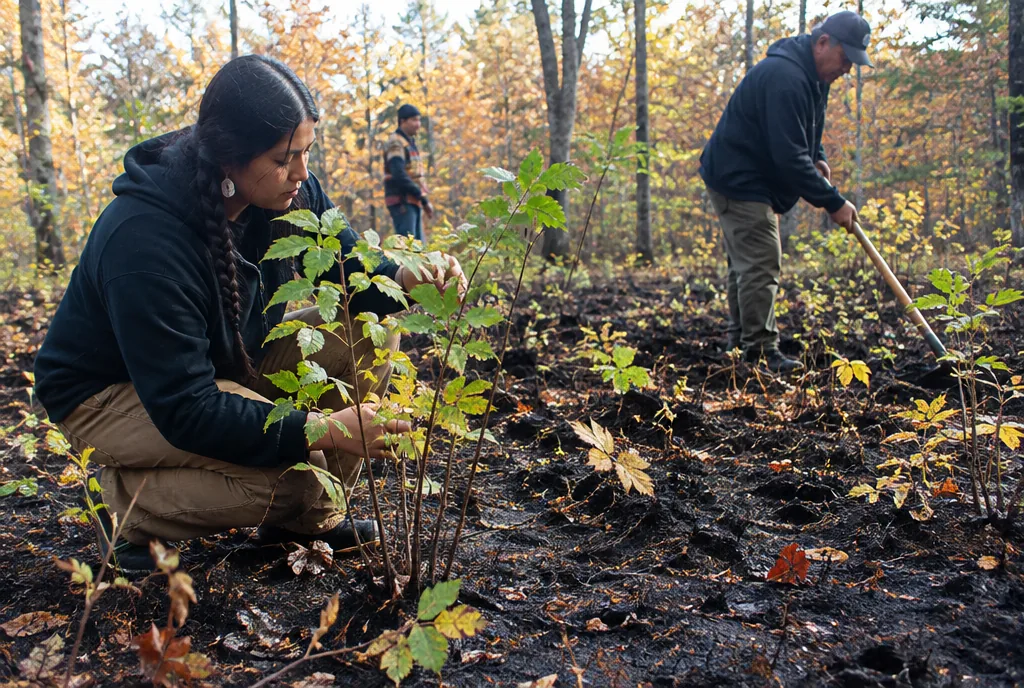
Fire stewardship in Northern California offers a concrete example. For centuries, the Karuk Tribe has used cultural burns to encourage hazel used in basket weaving. Without fire, hazel grows into dense, impenetrable brush. The example changes the usual image of fire from a simple danger to a management practice that can support a valued plant and cultural practice.
The work continues. In 2024, the Cultural Fire Management Council founded by Yurok tribal co-founder Margo Robbins conducted ten family burns and 24 cultural stewardship burns. The Indigenous Peoples Burning Network, founded in 2015, works to revitalize cultural burning and advance tribal self-determination in fire management. After a century of fire suppression contributed to extreme, difficult-to-control fires, traditional ecological knowledge is increasingly being included in modern wildfire strategies.
The October observance belongs to a wider Indigenous rights conversation
Indigenous Peoples’ Day is U.S.-specific, but its questions reach beyond U.S. borders. The United Nations estimates that more than 370 million Indigenous people live in roughly 70 countries. Their circumstances are diverse; no single holiday or term can capture them all.
In 2007, the U.N. General Assembly adopted the U.N. Declaration on the Rights of Indigenous Peoples by 143 votes to four, with 11 abstentions. The United States voted against the declaration in 2007 but later revised its position and now supports it. The declaration is a landmark in the international conversation about Indigenous rights, while local authority and specific histories remain essential to how those rights are understood.
October 12 itself has different meanings across the Americas. Mexico renamed the date the Day of the Pluricultural Nation by presidential decree in 2020. Within the United States, Native American Day also occurs on varying dates: South Dakota and Oklahoma observe it on October 12 in 2026, California and Nevada on September 25, and Arizona on June 7.
Common misunderstandings can obscure what the day means
Myth: Indigenous Peoples’ Day is already a federal holiday
It is not. Columbus Day remains the federal holiday on the second Monday in October. Indigenous Peoples’ Day may be recognized by a presidential proclamation, state, tribe, city, school, museum, or employer, but those forms of recognition do not automatically create a federal paid day off.
Myth: Replacing Columbus Day means Indigenous people are only part of the past
The purpose is the opposite. The day highlights continuing Indigenous presence, governance, culture, and knowledge. Cultural burning by Karuk and Yurok communities shows how a historical practice can remain relevant to land stewardship now.
Myth: Every place observes the day in exactly the same way
Names, dates, closures, and events differ. Berkeley’s Powwow and Indian Market, a county office closure, a museum open house, and a state holiday are all different forms of observance. The shared Monday should not be mistaken for a uniform national practice.
Myth: The choice is only between honoring one heritage and erasing another
The debate includes Italian American communities with differing views, as well as Indigenous advocates who object to celebrating Columbus because of the violence tied to his rule. Treating the issue as a choice between two simplified stories misses the historical stakes and the range of people involved.
Frequently Asked Questions
What is Indigenous Peoples’ Day?
It is an observance on the second Monday in October that recognizes Indigenous peoples, their histories, and their continuing presence. In many places it is observed on the same date as Columbus Day.
Is it Columbus Day or Indigenous Peoples’ Day?
Federally, the holiday is Columbus Day. States, cities, tribes, schools, and other institutions may observe Indigenous Peoples’ Day instead of, alongside, or independently of that federal designation.
Why did it change from Columbus Day to Indigenous Peoples’ Day?
Advocates sought a day centered on Indigenous peoples and objected to celebrating Columbus because of the violence, forced labor, enslavement, and devastating disease associated with his arrival and rule in the Caribbean.
Is Indigenous Peoples’ Day a federal holiday?
No. A presidential proclamation can recognize Indigenous Peoples’ Day, but it does not make it a federal holiday. Columbus Day remains the federal holiday, with federal agency closures and no mail delivery.
When is Indigenous Peoples’ Day 2026?
Indigenous Peoples’ Day 2026 is Monday, October 12. It falls on the same date as Columbus Day.
Is Monday, October 14 a federal holiday?
It was Columbus Day in 2024, when October 14 was the second Monday in October. The date changes each year; in 2026, the federal Columbus Day holiday falls on Monday, October 12.