An ecological niche is the full way a species makes a living: the conditions it can tolerate, the resources it uses, and the other organisms that shape its chances of surviving and reproducing. A forest, shoreline, or city can be a habitat; a niche explains what an organism does there, what limits it, and why another species may occupy the same place differently.
What an Ecological Niche Actually Describes
Think of a niche as a set of relationships rather than an address. Temperature and terrain are abiotic parts of that set. Predation and competition are biotic parts. Food, nesting places, the portion of a plant or shoreline an animal uses, and the range of conditions it can endure all belong in the picture. The niche therefore connects an organism’s surroundings to its behavior and persistence.
This is why “habitat” and “niche” are not interchangeable. Habitat names the physical setting: young jack pine, a rocky intertidal shore, or low urban vegetation. Niche asks a more demanding question: under which conditions can this species maintain itself there, which resources does it use, and how do competitors or predators change the answer? A Kirtland’s warbler and a brown rat illustrate the difference especially clearly. One breeds almost exclusively in a narrowly defined stage of jack pine; the other survives across many habitats.
| Question | Habitat | Ecological niche |
|---|---|---|
| What does it identify? | The physical place where an organism lives. | The conditions, resources, and interactions that allow it to live and reproduce. |
| What might it include? | A rocky shore, a young pine stand, or low vegetation. | Temperature tolerance, food use, nesting behavior, competition, and predation. |
| Why does it matter? | It locates an organism. | It explains its role and its limits within that location. |
The word itself once meant a recess in a wall for a statue, coming through Middle French nicher, “to nest.” Naturalist Roswell Hill Johnson first used “niche” in an ecological context in 1910. The word has since become central because it gives ecologists a way to describe both the setting around a species and the web of constraints within it.
From Place to Role: Three Views That Define Niche Ecology
The ecological niche definition has gained depth through three influential approaches. They are not competing dictionary entries so much as different views of the same problem: where a species can exist, what it does among other species, and how many conditions must align for that existence to continue.
Grinnell focused on where a species can persist
Joseph Grinnell was the first ecologist to use the term systematically in a research program, in his 1917 work on the California thrasher. His definition emphasized the environmental factors that determine where a species can survive, along with the behavioral adaptations that fit it to that place. This Grinnellian view keeps habitat at the center, but it does not reduce a niche to a point on a map. The relevant environment includes the features that make survival possible.
Elton focused on a species’ functional place
Charles Elton, writing in Animal Ecology in 1927, described a niche as an animal’s functional place in its community: its relation to food and enemies. The Eltonian niche puts food webs and trophic position in the foreground. A useful shorthand is not merely “where does it live?” but “what does it eat, what eats it, and which role does it occupy in the community?” For example, “carnivores that prey on small mammals” describes a functional position rather than a landscape.
Hutchinson turned the idea into a multidimensional space
In 1957, G. Evelyn Hutchinson formalized the niche as an n-dimensional hypervolume: the total set of environmental conditions under which a species can exist and reproduce. The mathematical image is helpful even without drawing a graph. One dimension might represent temperature, another terrain, another food, and another interaction with a competitor. A species persists only where those dimensions overlap in a workable combination.
Current ecology often brings these views together. A Grinnellian niche describes the habitat context; an Eltonian niche describes the functional role; Hutchinson’s framework makes room for the many conditions and interactions at once. That synthesis is the clearest answer to the question, “Which best describes an ecological niche?” It is the combination of a species’ environmental requirements, resource use, tolerance limits, and relationships with other organisms, not simply its address or a single “job.”
Fundamental Niche vs. Realized Niche: The Difference Nature Reveals
A fundamental niche is the full theoretical range of environmental conditions in which a species could live and reproduce if biotic constraints did not intervene. A realized niche is the portion that species actually occupies when competition, predation, and other limiting biological factors are present. The first is potential; the second is lived. Because organisms encounter other organisms in nature, the fundamental niche is almost never fully occupied.
The distinction prevents a common mistake. If a species is absent from part of a coastline or forest, that absence does not automatically prove the physical conditions are impossible for it. Another species may be excluding it, eating it, or otherwise narrowing the portion of its potential range that becomes its realized niche.
Connell’s barnacles make the distinction visible
Joseph Connell’s 1961 experiment on the Scottish coast is the classic demonstration. The larvae of Chthamalus stellatus settle across the tidal range. Yet adult Chthamalus survive only in the upper zone, while Balanus balanoides occupies the lower zone. At first glance, the distribution can look like a simple habitat preference: one barnacle high, one low. The experiment showed a more precise story.
When Connell removed Balanus, Chthamalus colonized the lower intertidal zone as well. Its fundamental niche therefore extended farther downward than its ordinary distribution suggested. Its upper boundary was set by physical factors (tolerance of heat and drying), while its lower boundary was set by competition with Balanus. The upper zone was the realized niche of Chthamalus, not the full range it could occupy in the absence of that competitor.
| Feature | Fundamental niche | Realized niche |
|---|---|---|
| Meaning | All conditions under which a species could live and reproduce without biotic restrictions. | The part actually occupied when interactions with other organisms matter. |
| Main limits | Environmental conditions and the species’ capacity to persist. | Those conditions plus competition, predation, and other biotic limits. |
| Chthamalus example | Includes upper and lower portions of the tidal range. | Normally restricted to the upper intertidal zone. |
How Competition Divides a Community
The logic behind the realized niche also explains why two species cannot occupy exactly the same niche indefinitely. The competitive exclusion principle, associated with Gause in 1934, states that species with identical niches cannot coexist permanently in the same habitat because they compete directly for the same resources.
Gause showed the pattern with two single-celled organisms. When Paramecium aurelia and P. caudatum grew separately, both reached high cell densities. When they grew together in the same medium, P. aurelia survived and P. caudatum was reduced to zero. The outcome gives the principle its force: a shared setting does not guarantee stable coexistence when the relevant niche requirements are identical.
Communities avoid that outcome through resource partitioning. Species may use different resources, different areas, or different times of day. The broad habitat can be shared while the realized niches remain distinct. This is not a claim that every neighbor in nature is in conflict. It is a way to see why small differences in food, position, or timing can make coexistence possible.
- Start with the resource or condition two species might share.
- Ask whether they use different portions of it, different places, or different times.
- Then ask whether a competitor, predator, or other interaction narrows either species’ actual use.
That sequence turns niche ecology from a label into an explanation. It links the broad rule about identical niches to a concrete observation in a particular community.
Ecological Niche Examples That Make the Concept Concrete
A strong ecological niche example includes more than an animal name and a location. It identifies a constraint, a resource, or an interaction that makes the species’ way of life distinctive. The following cases range from a highly specialized bird to lizards whose realized niche changed after an invasion.
Specialists depend on narrow conditions or resources
Koalas are specialist species because they eat almost exclusively eucalyptus leaves. That unusually narrow food use is part of their niche: the presence of a forest alone is not enough if the needed resource is absent.
The Kirtland’s warbler is another striking specialist. It breeds almost exclusively in young jack pine stands that are 5 to 20 years old and 1.5 to 5 meters tall. Its nest sits on the ground, concealed beneath the lowest jack pine branches, usually at the foot of a tree beside a fallen log. A male’s breeding territory covers 2.7 to 3.4 hectares, while its winter territory in the Bahamas is substantially larger, at 6.9 to 8.3 hectares. Those measurements show why a niche is more precise than “pine forest”: tree age, tree height, nest placement, season, and territory all matter.
In Shark Bay, Western Australia, bottlenose dolphins use marine sponges as tools while searching the seabed for prey. This is a culturally learned form of niche use. The example adds an important dimension to the usual list of food and physical conditions: learned behavior can change how members of a population obtain a resource.
Generalists can use a wider range of settings
Generalist species have broad, flexible niches. The brown rat, Rattus norvegicus, survives in many habitats. Brown anoles, Anolis sagrei, are also habitat generalists: they live on the ground and in low vegetation and occur in disturbed habitats, suburbs, and urban areas. A broad niche does not mean an organism has no limits; it means its usable range is wider than that of a specialist such as the koala or Kirtland’s warbler.
Florida anoles show a realized niche shifting upward
Before invasive brown anoles affect the setting, native green anoles, Anolis carolinensis, use the whole vertical axis from ground to canopy. After brown anoles arrive, green anoles shift into the upper 60 to 80 percent of the vegetation. The change is a realized niche shift: the green anole’s actual use of vertical space is narrowed by an interaction with another species.
The shift did not remain only behavioral. Within months of the invasion, green anoles began using higher branches. Within 15 years and 20 generations, their toe pads became larger and their adhesive scales more numerous. The case connects ecological niche to evolutionary change without treating the two as identical: competition altered where the lizards sat, and the altered conditions were followed by changes across generations.
Niche Construction Shows Organisms Can Change the Rules
Niche construction is the process by which organisms actively modify their environments and thereby change selection pressures on themselves and later generations. It differs from adaptation. Adaptation is a response to environmental pressure; niche construction changes the pressure itself.
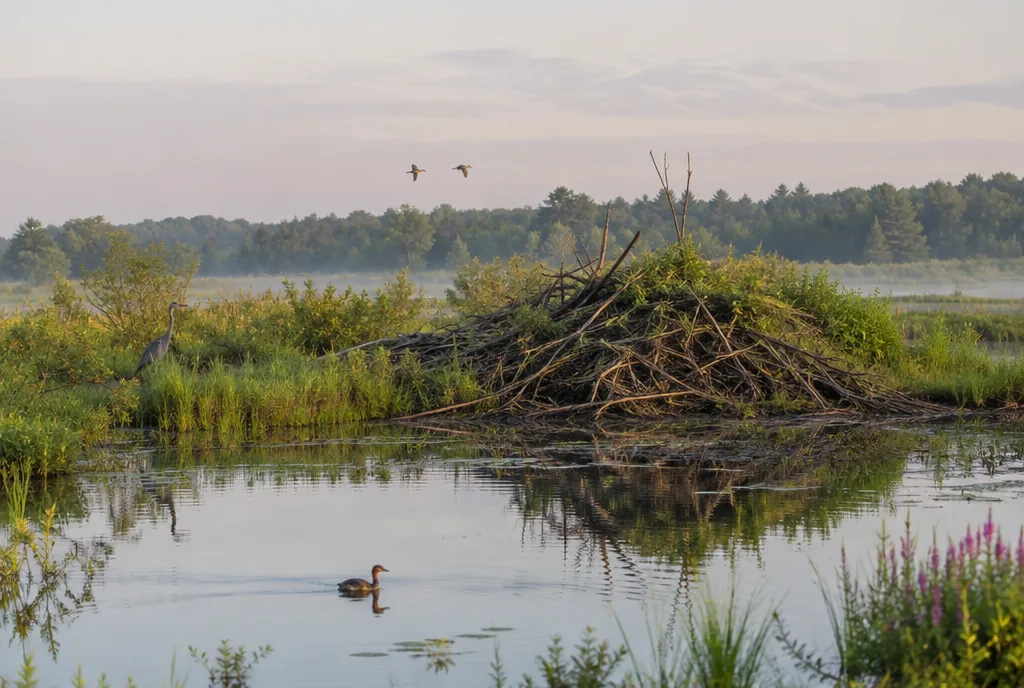
The North American beaver, Castor canadensis, is a classic ecosystem engineer. Its dams change water level, sediment dynamics, and nutrient cycling in flowing water. They also create wetlands that become habitat for aquatic plants, amphibians, and waterbirds. The beaver does not merely fit into a preexisting niche; by building dams, it helps create new niches for other organisms as well as a changed environment for itself.
Human cultural ecology offers an equally revealing example. Dairy farming in the Balkans around 7,500 years ago created a selective advantage for people who could digest lactose as adults. The European lactase-persistence allele -13,910*T was selected among dairy farmers in the region between the central Balkans and Central Europe around that time. In northern Europe, the allele now occurs at frequencies above 90 percent. This is a clear case of gene-culture coevolution: a cultural practice reshaped a dietary environment, and that environment influenced human genetics.
The scope of human niche construction is large. Agriculture now uses more than 38 percent of Earth’s ice-free land for crops or grazing. Such changes can have contrasting effects. Beaver dams can increase biodiversity by creating wetlands; livestock overgrazing can degrade soils. Niche construction is therefore not a synonym for improvement. It describes a feedback between organisms, environments, and the pressures that follow.
Common Misunderstandings That Blur the Idea
- “A niche is just a habitat.” A habitat is the place. A niche also includes resource use, tolerance ranges, and relationships with other species.
- “A niche is only an organism’s job.” Functional role matters in Elton’s view, but the full concept also includes environmental conditions and the ability to reproduce.
- “The fundamental niche is where a species really lives.” It is a theoretical full range without biotic constraints. The realized niche is the part actually occupied.
- “A niche stays fixed.” Competition can shift realized niche use, as with Florida green anoles, and niche construction can alter the conditions organisms face.
- “Generalists and specialists are simply better and worse.” They describe breadth. Brown rats use many habitats; Kirtland’s warblers depend on a much narrower breeding setting.
These distinctions matter because a vague use of “niche” hides the mechanism. The point is not to assign every organism a catchy job title. It is to identify the conditions and interactions that explain its distribution, survival, reproduction, and effects on a community.
Frequently Asked Questions
What is meant by ecological niche?
An ecological niche is the combination of conditions, resources, tolerance ranges, and interactions with other organisms that allows a species to survive and reproduce. It is broader than the place where the species lives.
What are examples of ecological niches?
A koala’s near-exclusive use of eucalyptus leaves, a Kirtland’s warbler’s breeding use of young jack pine stands, and Shark Bay dolphins’ sponge-tool foraging are examples. Green anoles shifting to the upper 60 to 80 percent of vegetation after brown anoles arrive show a realized niche change.
Which best describes an ecological niche?
The best description is a species’ multidimensional way of life: its environmental requirements, resources, tolerance limits, and biotic relationships. It is not merely its habitat or a single role in a food web.
What is the difference between a fundamental niche and a realized niche?
The fundamental niche is the full theoretical range where a species could live and reproduce without biotic constraints. The realized niche is the smaller or altered portion it actually occupies when competition, predation, and other interactions occur.
What is niche construction?
Niche construction occurs when organisms alter environmental conditions and therefore the selection pressures that affect them and other species. Beaver dams and human dairy farming are two examples with very different ecological and cultural consequences.