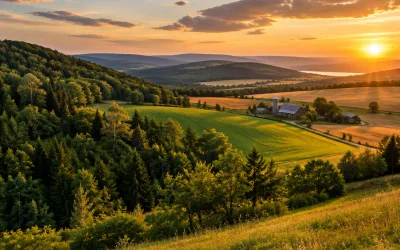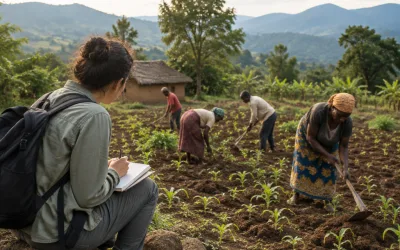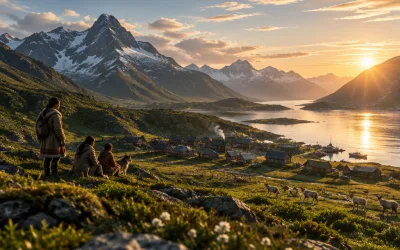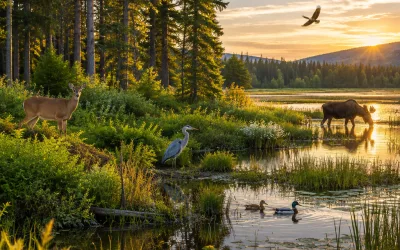
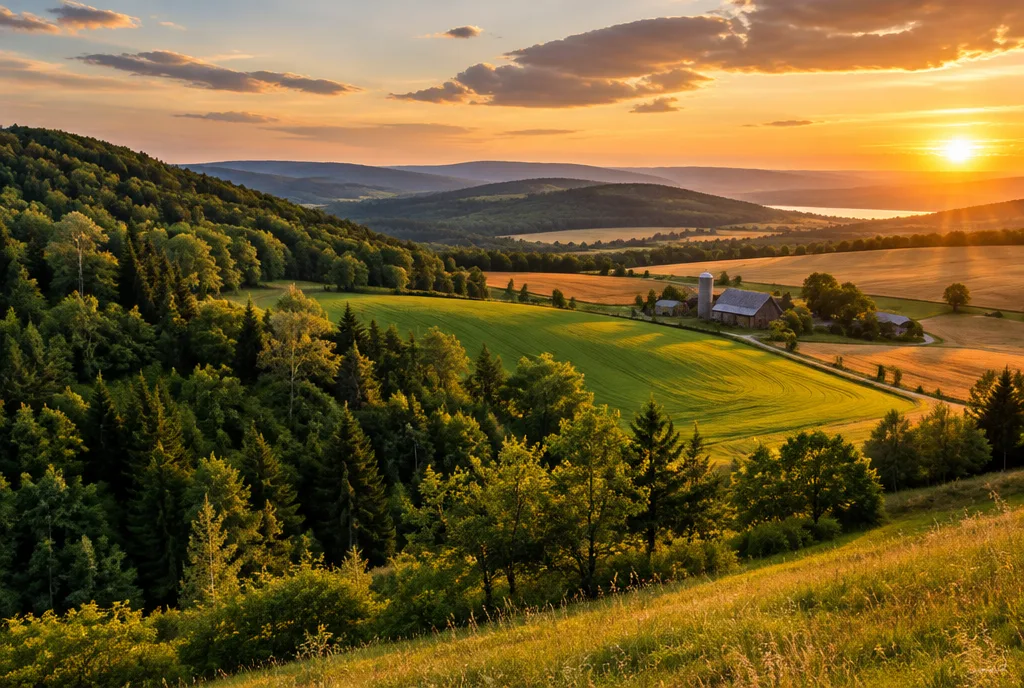
Almost no landscape on earth is untouched by people. Fields, hedgerows, terraces, irrigation canals, pastures, managed forests and even many apparently wild savannas are the result of centuries of human use. The concept of the cultural landscape captures this: it treats landscapes as shared products of nature and culture. For ecologists and anthropologists alike, it is a way to understand how human choices, from farming methods to everyday consumption, leave lasting marks on the land.
The concept of the cultural landscape
The term was made influential by the American geographer Carl Sauer. In his 1925 essay The Morphology of Landscape, he wrote that the cultural landscape is fashioned from a natural landscape by a culture group: culture is the agent, the natural area the medium, and the cultural landscape the result. Sauer and his students at the University of California, Berkeley, went on to study how farming, fire and livestock had transformed landscapes in Mexico, the Caribbean and the American West.
Sauer’s idea had European roots in the German concept of Kulturlandschaft, used by geographers to describe landscapes shaped by settlement and agriculture. It also connected with anthropology: Julian Steward, founder of cultural ecology, was influenced by Sauer during his years at Berkeley.
Today the concept is used in geography, archaeology, landscape ecology, heritage protection and planning. It reminds researchers that a landscape has a history, and that its current ecology cannot be understood without that history.
Cultural landscapes as world heritage
In 1992 the UNESCO World Heritage Convention became the first international legal instrument to recognize and protect cultural landscapes. It defines three categories:
- Designed landscapes: gardens and parks created intentionally, often for aesthetic reasons, such as the landscape gardens of eighteenth-century England.
- Organically evolved landscapes: landscapes that developed through long interaction between a society and its environment. Some are relict, others still in use.
- Associative landscapes: places with powerful religious, artistic or cultural associations, even where material traces are few.
The first site inscribed as a cultural landscape was Tongariro National Park in New Zealand in 1993, recognized for its spiritual significance to the Māori people. Uluru-Kata Tjuta in Australia followed in 1994. Other well-known cultural landscapes include:
- Rice Terraces of the Philippine Cordilleras (1995): terraces built by the Ifugao over some two thousand years, sustained by communal water management and rituals.
- Loire Valley in France (2000): châteaux, towns and vineyards along the river.
- Tokaj Wine Region in Hungary (2002): vineyards, farms and cellars that have produced wine for over a thousand years.
- Agave Landscape near Tequila, Mexico (2006): blue agave fields and distilleries.
In the United States, the National Park Service manages cultural landscapes such as historic farms, battlefields, parkways and designed grounds, and has developed guidelines for documenting and preserving them.
Landscape ecology
While heritage protection focuses on history and meaning, landscape ecology studies the spatial pattern of ecosystems and how it affects species and processes. The American ecologist Richard Forman, together with Michel Godron, described landscapes in terms of three elements:
- Patches: relatively uniform areas such as a woodlot, a field or a pond.
- Corridors: linear strips such as hedgerows, rivers, roads or railway embankments.
- Matrix: the dominant background, such as cropland or forest, in which patches and corridors are embedded.
This vocabulary helps explain why the arrangement of land uses matters. A small forest patch surrounded by intensive cropland supports fewer species than the same area connected to other forests by hedgerows or stream corridors. Roads can block the movement of amphibians; wildlife bridges and underpasses can restore connections. In agricultural regions, field margins, ditches and old stone walls often provide much of the remaining habitat.
Examples of ecology in cultural landscapes
European hedgerows
In Britain, Normandy and northern Germany, networks of hedgerows were planted over centuries to mark property and contain livestock. They became habitat for birds, small mammals, insects and flowering plants, and corridors that connect woodlands. When hedgerows were removed on a large scale after the Second World War to create larger fields, farmland bird populations declined. Several countries now pay farmers to maintain and replant them.
Satoyama in Japan
Satoyama describes the traditional mosaic of villages, rice paddies, irrigation ponds, grasslands and managed coppice forests at the foot of Japanese mountains. Regular cutting of trees for firewood and charcoal and the flooding of paddies created varied habitats for dragonflies, frogs, birds and wildflowers. As rural populations age and practices are abandoned, many satoyama species decline, which shows that some biodiversity depends on continued human use rather than on its absence.
Mediterranean dehesa
In southwestern Spain and Portugal, the dehesa or montado combines open oak woodland with grazing by pigs, cattle and sheep, cork harvesting and occasional cropping. The system supports high biodiversity, including rare birds such as the Spanish imperial eagle, and produces cork and Iberian ham.
Indigenous fire landscapes
Many landscapes once described as wilderness were shaped by Indigenous burning. In California, Australia and the North American prairies, regular low-intensity fires set by Indigenous peoples kept grasslands open, encouraged food plants and reduced the buildup of fuel. When colonial governments suppressed these fires, forests grew denser and large, destructive wildfires became more common. Land managers in California and Australia now work with Indigenous fire practitioners to reintroduce cultural burning.
Everyday choices and the landscape
Cultural landscapes are not only historical. They are reshaped continuously by decisions that seem far removed from the land: what people eat, how they travel, where they live and what they buy. Demand for beef and soybeans changes land use in South America; demand for palm oil does so in Southeast Asia. Suburban growth converts farmland and forests into lawns and roads. At the same time, consumer demand for organic products, certified wood or regionally produced food can support landscapes that combine production with habitat.
Social norms play a role as well. When recycling, cycling or buying local food become common practice in a community, they spread partly because people follow what their neighbors do. Cultural ecology treats such norms as part of how a society adapts to its environment.
Frequently Asked Questions
Who coined the term cultural landscape?
The geographer Carl Sauer made it influential in his 1925 essay The Morphology of Landscape, drawing on the German term Kulturlandschaft.
What was the first UNESCO cultural landscape?
Tongariro National Park in New Zealand, inscribed as a cultural landscape in 1993.
What are patches, corridors and matrix?
The basic elements of a landscape in landscape ecology: uniform areas, linear connecting strips and the dominant background land use.
Why can abandoning traditional land use harm biodiversity?
Many species depend on habitats created by practices such as mowing, grazing or coppicing. When these stop, open habitats become overgrown and the species decline.