The social ecological model explains why a health behavior cannot be understood as a private choice alone. It maps the influences around a person—from knowledge and close relationships to organizations, neighborhoods, laws, and historical change—and asks how those influences interact. Also called the socio-ecological model, it is a practical way to connect ecological thinking with public health: people shape their environments, while environments shape what people can do.
Why the Social Ecological Model Changes the Question
A narrow explanation of health starts and ends with the individual: what someone knows, believes, or decides. The social ecological model widens the frame. It treats behavior as the result of influences operating at several levels at once, including personal factors, relationships, institutions, communities, and public policy. That does not erase individual agency. Instead, it places agency in the settings where it is exercised.
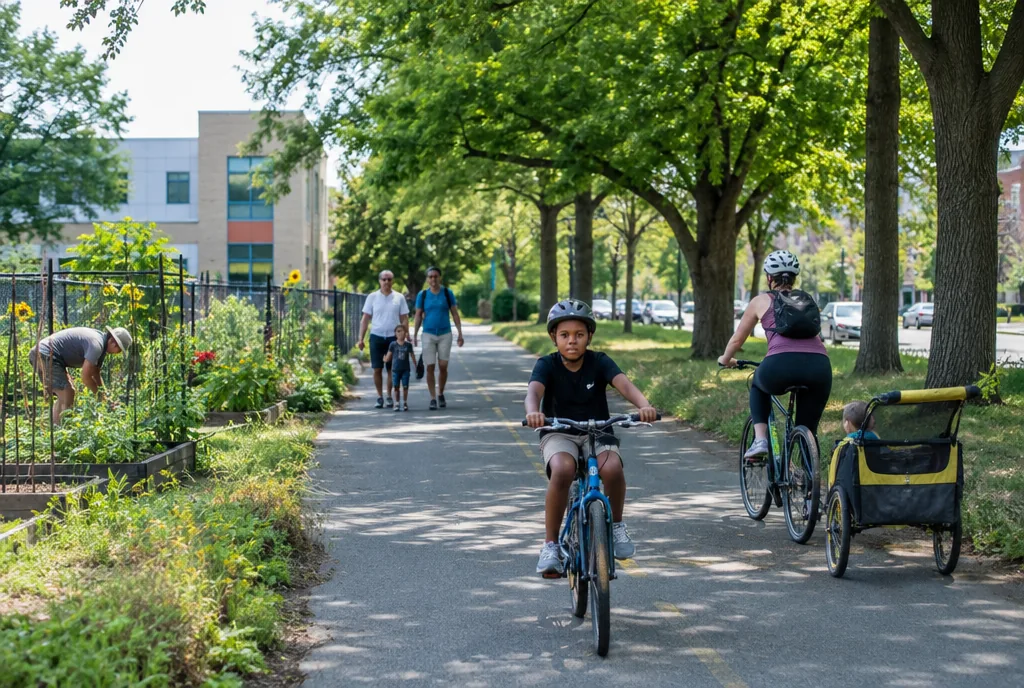
This matters because the same behavior can look very different when its context becomes visible. Food choices, for example, can be considered alongside family meals, school cafeterias, access to food, and a sugar tax. Cycling can be considered alongside riding skills, support from peers, bike lanes, municipal programs, and a national cycling strategy. A useful explanation checks each level rather than treating one of them as the whole story.
At the individual level, the model can identify knowledge, beliefs, or skills. Within close relationships, it can ask how family, peers, partners, or coworkers reinforce a practice. Inside organizations, it can examine rules and structures in settings such as schools, workplaces, and churches. Across a community, it can consider the ties among institutions, local norms, and informal networks. At the public-policy level, it can bring laws, regulations, and guidelines into view. Moving through these questions prevents a false choice between personal action and collective conditions: the model treats them as connected parts of the same ecological system.
In public health, the model serves as a bridge between individual behavior and the structural determinants of health. Its central proposition is reciprocal: individuals and environments influence one another. A health-promotion effort can therefore build skills while also working on the rules, settings, and norms that make those skills easier or harder to use.
Who created the model? Its roots lead through several fields
There is no single inventor of every version now called the social ecological model. Its most important developmental foundation is Urie Bronfenbrenner’s Ecological Systems Theory. A Russian-American developmental psychologist, Bronfenbrenner began formulating that theory in the early 1970s. His 1977 American Psychologist article, “Toward an experimental ecology of human development,” and his 1979 book The Ecology of Human Development: Experiments by Nature and Design made the framework influential.
Bronfenbrenner objected to developmental research that observed children in brief, artificial encounters with unfamiliar adults. His alternative was ecological: development unfolds in real settings and in the connections among them. He described the environment as nested structures, each inside the next, like Russian dolls. Development, in his account, is a progressive and mutual accommodation between an active, growing person and the changing properties of immediate settings.
That language supplied a powerful framework, but it was not yet the standard public-health version of SEM. Daniel Stokols, a pioneer of social ecology at UC Irvine, focused more explicitly on social and environmental dimensions of health. Kenneth R. McLeroy, Daniel Bibeau, Allan Steckler, and Karen Glanz then adapted ecological thinking for health promotion. Their framework named five levels of influence that remain central when the model is used in public health.
The related labels can be confusing. “Social ecological model” and “socio-ecological model” are synonyms. “Ecological model,” “social ecology,” and “Ecological Systems Theory” are closely related, but they are not interchangeable names for one fixed theory. Bronfenbrenner’s work centers on development; Stokols’s social ecology addresses people, social settings, physical environments, and health; McLeroy and colleagues offered a health-promotion framework.
The five ecological systems show how contexts nest together
Bronfenbrenner’s five systems are a way of locating a person in a layered environment. The levels do not simply form a ladder from small to large. They describe direct contact, connections among direct settings, indirect influence, broad cultural conditions, and time.
| System | What it includes | Why it matters |
|---|---|---|
| Microsystem | Immediate settings such as family, school, and peers, with direct face-to-face interaction. | This is where everyday contact occurs. |
| Mesosystem | Relationships between two or more microsystems, such as the connection between home and school. | It focuses on how immediate settings meet and affect one another. |
| Exosystem | Settings in which the individual does not directly participate, such as a parent’s workplace or a school board. | Indirect decisions and conditions can still affect daily life. |
| Macrosystem | The wider cultural, political, and economic level: laws, values, traditions, and ideologies. | It identifies the larger arrangements surrounding local settings. |
| Chronosystem | Life events, historical changes, and changes across the life course. | It adds time to the analysis. |
These categories make a basic analytical move possible. A child’s school belongs in the microsystem when it is a direct setting. The relationship between school and home belongs in the mesosystem. A school board can belong in the exosystem when its decisions affect the child without the child participating in them. Laws, values, and ideologies belong at the macrosystem level. Historical change or a turning point in a life belongs in the chronosystem.
That distinction guards against a common shortcut: calling every influence “community.” Ecological Systems Theory is more precise. It asks whether an influence is direct or indirect, whether it links settings, how broad it is, and how it changes through time.
The five social ecological model levels guide health promotion
McLeroy and colleagues translated ecological thinking into five levels for health promotion. Their article, “An Ecological Perspective on Health Promotion Programs,” is one of the most cited articles in health-promotion literature, with more than 10,000 citations. The levels shift attention from development across nested systems to the influences a health-promotion program may need to address.
- Intrapersonal factors: knowledge, attitudes, beliefs, self-concept, and skills within an individual.
- Interpersonal factors: family, friends, peers, and coworkers whose relationships shape and reinforce behavior.
- Institutional or organizational factors: workplaces, schools, churches, and their formal or informal rules and structures.
- Community factors: relationships among organizations and institutions, neighborhood norms, and informal networks.
- Public policy: local, state, and federal laws, regulations, and policies that can support or obstruct healthy behavior.
The names should not be forced into one-to-one matches with Bronfenbrenner’s five systems. Intrapersonal factors are not simply the microsystem, and public policy is not simply the macrosystem. The two schemes answer related but different questions. Bronfenbrenner’s levels explain the structure of environmental influence on development. McLeroy’s levels organize possible influences and intervention targets for health promotion.
A four-level version is also widely used. For violence prevention, the CDC describes individual, relationship, community, and societal levels. At the individual level, factors can include age, education, income, substance use, and a history of abuse. Close peers, partners, and family belong at the relationship level. Schools, workplaces, and neighborhoods form community settings, where poverty, segregation, and limited recreational opportunities are relevant structural features. Societal factors include norms, cultural acceptance of violence, and health, education, and economic policy.
Neither the four-level CDC version nor the five-level health-promotion version is the single universal list. They are adaptations for different purposes. A careful article or program names the version it is using instead of silently combining the labels.
Four principles keep the model from becoming a checklist
In 1992, Stokols articulated four core assumptions of a social-ecological perspective. Together, they explain why simply listing levels is not enough.
1. Physical and social environments belong in the same analysis
Geography, architecture, and technology are environmental factors, as are relationships, norms, and institutions. An analysis limited to social factors can miss the physical setting; one limited to physical design can miss the social processes occurring within it. The cycling example makes this visible: peer support is social, while bike lanes are part of the physical environment.
2. Environments differ in scale and complexity
Environments can be physical or social, objectively present or subjectively perceived, immediate or distant. Family meals and school cafeterias are close settings in an obesity example. Food access is a community condition, while a sugar tax operates through policy. The model asks analysts to notice those differences rather than treating “environment” as one undifferentiated background.
3. Multiple levels require multiple methods
Stokols’s perspective draws on diverse methods, including epidemiology, environmental measurement, surveys, and behavioral observation. No single method can capture all levels equally well. Environmental measurement can examine a physical setting; a survey can record experience or perception; behavioral observation can focus on what people do; epidemiology can identify patterns at a population level.
4. Person–environment relationships are cyclic and reciprocal
People change environments and are changed by them. This principle rejects a one-way story in which settings merely act on passive individuals. It also explains why health promotion can combine personal learning with changes to the social or physical conditions around people. The relevant unit is the transaction between person and environment, not either side in isolation.
Use a multi-level plan to connect skills, settings, and policy
A practical SEM plan begins by mapping a problem across levels, then looking for measures that complement one another. The model does not prescribe one intervention. It supplies a disciplined way to make sure that a plan does not stop at the individual when the relevant influences extend farther out.
- State the health issue clearly. Identify the individual factors, close relationships, organizational settings, community conditions, and policies that the chosen version of the model makes visible.
- Separate direct from indirect influence. A family meal is an interpersonal setting; a school cafeteria is organizational; food access is a community condition; a sugar tax is a policy measure.
- Pair actions across levels. In obesity prevention, individual education can sit alongside family meals, school cafeterias, food access, and a sugar tax. The value lies in the combination rather than in declaring any one element sufficient.
- Check the physical environment as well as the social one. In cycling, individual riding education and peer support address personal and interpersonal factors. Bike lanes, municipal programs, and a national cycling strategy place those factors in wider physical and policy contexts.
- Include time where it changes the problem. Bronfenbrenner’s chronosystem reminds planners that life events and historical shifts can alter the conditions under which a program operates.
The CDC’s violence-prevention application provides a compact illustration. It connects conflict-resolution training at the individual level, parenting programs at the relationship level, after-school programs for young people at the community level, and social norms against violence at the societal level. The example does not reduce violence prevention to any one component. It shows the distinct kinds of action a multi-level framework can hold together.
Public health often reaches the individual level first
The appeal of the social ecological model is also a critique of common practice. Golden and Earp analyzed 157 intervention articles published over 20 years in Health Education & Behavior. Ninety-five percent included individual-level activities, while only 20 percent included community- or policy-level activities. Fewer than 10 percent explicitly named an ecological theory as the basis for the intervention.
Those figures do not mean individual-level work is unimportant. Knowledge, attitudes, beliefs, self-concept, and skills are explicitly part of the model. They show, instead, how easily the outer levels disappear from practice. When programs focus only on the individual, the organizational rules, neighborhood conditions, and policies that constrain or enable behavior may remain unchanged.
The model’s sustainability claim follows from this broader view: interventions that address only one level are less sustainable than multi-level approaches. In 2015, Golden, McLeroy, Green, Earp, and Lieberman proposed “upending” the model so that policy and environmental change come first rather than appearing as the final, outermost step. The proposal is a useful warning against drawing concentric circles and then investing only in the center.
Common misunderstandings make the framework less useful
Myth: the model is a fixed set of circles with one official vocabulary
Different versions have different purposes. Bronfenbrenner’s five systems include a chronosystem. McLeroy’s five health-promotion levels include public policy. The CDC’s violence-prevention adaptation uses four levels. The useful question is which version fits the problem and whether its terms are used consistently.
Myth: social ecology means only social relationships
Stokols’s approach explicitly includes physical environmental factors such as geography, architecture, and technology. Bike lanes are not an afterthought to a social model; they are part of the environment in which social support and individual skills matter.
Myth: ecological thinking removes responsibility from individuals
The model includes intrapersonal factors and treats people as active participants in reciprocal relationships with their environments. It does not deny personal action. It avoids explaining outcomes as if personal action occurred outside families, institutions, communities, policies, and time.
Myth: every program must use exactly one action at every level
The framework is an analytic guide, not a quota system. Its four principles call for attention to multiple levels, diverse methods, and the interplay of personal and environmental factors. A good application identifies relevant influences and does not confuse a complete-looking checklist with a credible explanation.
Frequently Asked Questions
What are the 5 levels of the socio-ecological model?
In McLeroy and colleagues’ health-promotion version, the five levels are intrapersonal, interpersonal, institutional or organizational, community, and public policy. Each points to a different kind of influence on health behavior.
What is an example of a social ecological system?
Obesity prevention offers a clear example: individual education, family meals, school cafeterias, community food access, and a sugar tax can be examined together. The example links personal knowledge with relationships, organizations, community conditions, and policy.
What are the four core principles of the social ecological model?
Stokols’s four assumptions are that analysis should include physical and social factors; environments vary by scale and complexity; multiple levels require diverse methods; and person–environment transactions are cyclic and reciprocal.
Who created the social ecological model?
The model has several roots rather than one sole creator. Bronfenbrenner developed Ecological Systems Theory for understanding development; Stokols articulated a social-ecological perspective; and McLeroy, Bibeau, Steckler, and Glanz adapted ecological thinking for health promotion.
Why do some social ecological model levels number four and others five?
They are different adaptations. McLeroy’s health-promotion framework has five levels. The CDC uses a four-level individual, relationship, community, and societal version for violence prevention. Both are useful when their specific purpose is made clear.