The Arctic tundra biome is the treeless belt around the Arctic Ocean, where a brief burst of summer life takes place above ground that can remain frozen for years. It extends across Alaska, Canada, Greenland, Scandinavia, and Siberia, north of the taiga and generally above 60°N. Sparse-looking at first glance, this biome ties tiny plants, migrating caribou, lemming cycles, predators, carbon-rich soil, and human communities into one tightly linked system.
Where the Arctic Tundra Begins—and Why Trees Stop There
Arctic tundra lies beyond the tree line, the boundary north of which trees cannot survive. It surrounds the Arctic Ocean along the northern edges of North America, Greenland, Scandinavia, and Russia, and covers roughly 10 percent of Earth’s surface. The Arctic Circle, at about 66°34′N, is often used to mark its southern edge, though the ecological boundary is better understood through the tree line and the conditions that prevent forest growth.
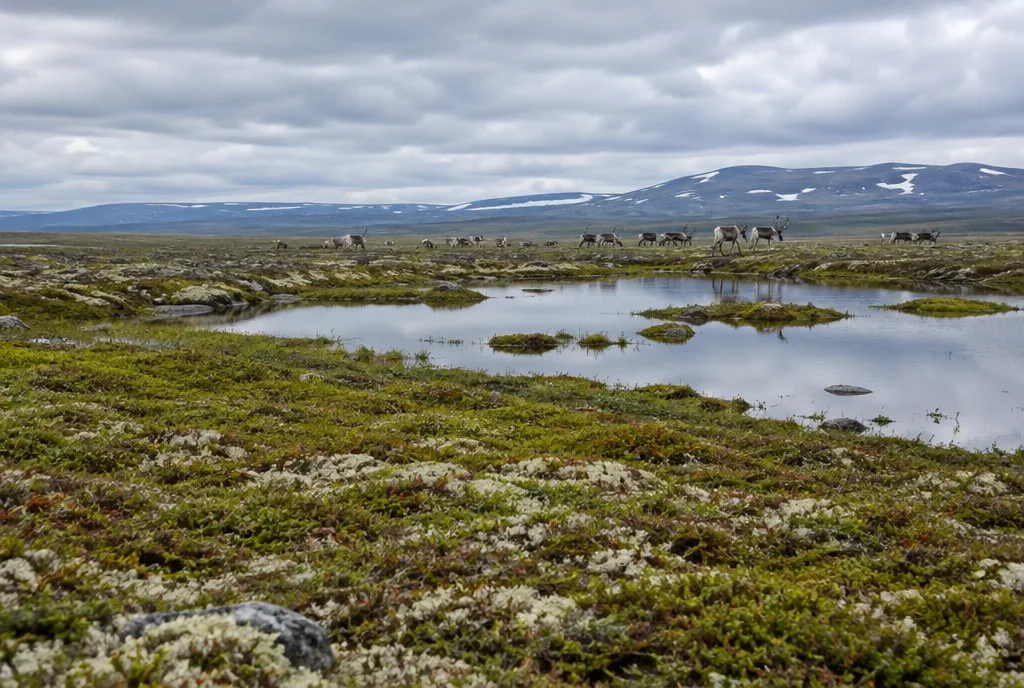
The word tundra comes from the Finnish tunturi, meaning “treeless plain.” That name points to a defining feature, but not to an empty one. At ground level, the landscape can hold dense mats of moss, lichens, sedges, grasses, and dwarf shrubs. Its scale is continental; its growing space is thin.
Why the Arctic Climate Is More Than Simply Cold
In the Arctic tundra, bitter winters give way to a short but surprisingly intense summer. In winter, average temperatures are about −30°F (−34°C), while summer averages reach only 37–54°F (3–12°C). In the coldest regions, winter temperatures can fall to −58°F (−50°C). At high latitudes, winter also brings weeks of polar night.
Annual precipitation is only 6–10 inches (15–25 centimeters), less than in most deserts. Yet during summer, the tundra often looks wet. This is not a product of heavy rain: frozen ground below the surface prevents meltwater from draining downward. Pools and saturated soil can therefore form above a landscape that receives very little precipitation.
| Condition | What it means in the Arctic tundra |
|---|---|
| Winter | Average temperature near −30°F, with polar night at high latitudes. |
| Summer | Average temperature of 37–54°F and up to 24 hours of sunlight. |
| Growing season | Only 50–60 days for plants to grow, flower, and set seed. |
| Precipitation | Just 6–10 inches annually, although summer ground can be waterlogged. |
For a few summer weeks, the sun may remain visible for 24 hours. That midnight sun accelerates plant growth, but it does not erase the time limit: the soil surface is ice-free for only 50–90 days. Arctic plants must use light, water, and warmth quickly.
Permafrost Sets the Rules Below the Surface
Permafrost is ground that remains frozen year-round. In Siberia, it reaches depths of up to 1,450 meters (about 4,760 feet). Above it sits the active layer, the band that thaws in summer and refreezes in winter; it is typically only 25–90 centimeters (about 10–35 inches) thick. Roots grow, water collects, and much of tundra life takes place in this shallow, shifting layer.
Permafrost matters far beyond the Arctic because Northern Hemisphere permafrost soils hold an estimated 1,460–1,600 billion tons of carbon—about twice the carbon in the atmosphere. A frozen soil layer therefore works as both a physical barrier for roots and drainage and a vast carbon store. Where the annual average temperature rises above 32°F (0°C), the active layer can deepen by more than 3 feet (1 meter) within a few years.
Plants Turn a Tiny Summer Window Into Survival
About 1,700 plant species grow in the tundra, including dwarf shrubs, mosses, grasses, sedges, and lichens. In the High Arctic, mosses and lichens dominate. Lichens do more than add color to exposed ground: they buffer the soil microclimate and soften temperature extremes close to the surface.
Plant shape is the answer to wind, cold, shallow soil, and scarce time. Many species grow as low cushions or rosettes, which protects them from wind and lets them use warmth close to the ground. Their roots stay shallow because permafrost blocks deep growth. Small leaves reduce water loss, while hairy stems and dark leaves help retain heat. Most are perennials that survive the winter under the snow rather than starting from scratch each spring.
Purple saxifrage makes the brief season visible. It can flower so early that its blooms appear while snow is still on the ground. Early flowering gives the plant as much of the short season as possible to set seed.
Caribou, Arctic Foxes, and Lemmings Reveal the Cost of Cold
Tundra animals do more than endure the cold; their bodies and movements are built around it. Caribou can migrate as far as 640 kilometers (about 400 miles) between summer and winter ranges. The changes they face are already substantial: Arctic caribou populations declined by 65 percent in 20–30 years, from 5.5 million to 1.88 million animals. By 2100, the number of days above 66°F (19°C) on summer ranges could rise from 14 to as many as 38, which is linked to 8 percent less food intake.
The Arctic fox uses a different strategy. Its winter coat is 140 percent thicker than its summer coat and works together with small ears and a short muzzle to reduce heat loss. The fox can hear lemmings under as much as 40 centimeters (about 16 inches) of snow, so its survival depends on the hidden movements of small rodents beneath the surface.
Lemming numbers rise and crash in boom-and-bust cycles of three to five years. Their importance far exceeds their size: their droppings fertilize plants that caribou and Arctic hares eat, and they are a key food for predators. An animal that is almost invisible from a distance can anchor a food web.
The Arctic Tundra Food Web Is a Network, Not a Ladder
An Arctic tundra food web begins with producers: lichens, mosses, grasses, dwarf shrubs, and phytoplankton. Primary consumers include lemmings, caribou, Arctic hares, ptarmigan, and voles. Arctic foxes, stoats, snowy owls, skuas, and gyrfalcons are among the secondary consumers. Polar bears and Arctic wolves are top predators, while fungi and bacteria break down dead organic material during the short summer.
- Plant layer: mosses, lichens, grasses, dwarf shrubs, and phytoplankton capture energy.
- Grazers and small herbivores: caribou and lemmings move that energy through the system.
- Predators: foxes and snowy owls respond quickly when lemming numbers change.
- Decomposers: fungi and bacteria return nutrients from dead matter to the living system.
The snowy owl shows why a chain is too simple a model. In a lemming-scarce year, snowy owls may lay no eggs; in a good lemming year, they can lay up to 11. When lemmings are scarce, predators shift toward alternative prey. A fluctuation in one small mammal can therefore cascade through breeding, predation, plant fertilization, and other levels of the web. Polar bears occupy a related but distinct position, hunting mainly seals on sea ice; loss of sea ice threatens that role.
Climate Change Is Rewriting the Tundra From the Ground Up
The Arctic is warming twice as fast as the global average. As permafrost thaws, it can alter the physical landscape abruptly through landslides and ground change, while also changing the carbon balance. Parts of the tundra are already releasing more carbon dioxide and methane than they absorb. Thawing permafrost can reduce carbon budgets for the 1.5°C and 2°C targets by as much as 20–22 percent.
This is a feedback problem: thaw exposes carbon held in frozen ground, and emissions from that carbon add to warming. Methane emissions from permafrost are estimated at 0.5–2 petagrams of carbon per year and account for 40–70 percent of carbon feedbacks. The consequences are ecological and practical at once, reaching plant communities, animal forage, land stability, and the places where people live.
Indigenous Communities Belong in the Story of the Tundra
The tundra is not an uninhabited wilderness. More than 180,000 Inuit live in Alaska, Canada, Greenland, and Chukotka. Inuit communities have longstanding relationships with this region; traditional food systems include seals, walruses, whales, caribou, birds, and fish, with little plant food available. Harpoons were used for seals, while kayaks and larger skin boats called umiaks supported whale hunting.
These are not only historical practices. Thawing permafrost threatens infrastructure and subsistence economies, and declining caribou populations can affect hunting. Inuit communities also face language loss, urbanization, social inequality, and marginalization. Founded in 1977, the Inuit Circumpolar Council represents Inuit internationally, underscoring that Arctic change involves peoples with continuing political voices and knowledge, not a landscape without residents.
Three Common Tundra Myths
Myth: The tundra is a frozen desert with almost no life
Low trees do not mean low complexity. The tundra includes roughly 1,700 plant species, migratory caribou, small mammals, birds of prey, decomposers, and coastal food-web connections.
Myth: Little precipitation means the ground stays dry
Summer ground can be wet because permafrost blocks drainage. The tundra receives only 6–10 inches of precipitation a year, but water can remain near the surface.
Myth: The food web is a simple line from plant to predator
Lemming cycles show the opposite. Their changing abundance can affect owl breeding, predator behavior, plant fertilization, and alternative prey across several links at once.
Frequently Asked Questions
Where is the Arctic tundra biome?
It lies north of the taiga around the Arctic Ocean, across Alaska, Canada, Greenland, Scandinavia, and Siberia. The tree line marks its ecological southern boundary.
What is the climate of the Arctic tundra?
Average winter temperatures are about −30°F, while average summers reach 37–54°F. Annual precipitation is only 6–10 inches, and the growing season lasts just 50–60 days.
What plants live in the tundra?
Mosses, lichens, grasses, sedges, dwarf shrubs, and flowering plants such as purple saxifrage live there. Many stay low to the ground and use shallow roots above permafrost.
What animals live in the Arctic tundra?
Caribou, lemmings, Arctic hares, Arctic foxes, snowy owls, stoats, skuas, gyrfalcons, polar bears, and Arctic wolves are among the animals connected to tundra food webs.
How is climate change affecting the tundra?
Rapid Arctic warming deepens thaw in permafrost, destabilizes land, and can release carbon dioxide and methane. It also affects caribou forage, infrastructure, and subsistence economies.