Biodiversity is the variety of life at three connected levels: genetic differences within a species, the mix of species in a community, and the range of ecosystems across a landscape or seascape. Real-life biodiversity examples can be as small as the genes in a crop variety or as vast as the Amazon rainforest and the Great Barrier Reef. The striking part is that these levels are linked: a population can lose genetic options, a community can lose species, and a region can lose the habitats that allow both to persist.
What biodiversity looks like beyond a list of animals
Although people often picture biodiversity as a crowded rainforest scene, it is not simply a tally of colorful animals. The idea covers the variation of genes and alleles within a species, the number and distribution of species in a place, and the habitats and ecological processes that make a region more than a collection of organisms. One biodiversity example is a desert with Joshua trees, pronghorn antelope, desert tortoises, and cutthroat trout; another is a prairie shaped by drought, fire, and grazing or a coral reef assembled from corals, fish, sea stars, worms, sharks, and plankton.
Scale changes the question. At a local scale, a coral reef off northern Australia may host 500 fish species, while a comparable rocky shoreline in Japan may host about 100. At a global scale, an estimated 8.7 million eukaryotic species exist, with an uncertainty of 1.3 million. Only about 1.2 million have been described and cataloged, leaving an estimated 86% of land species and 91% of marine species undiscovered. Biodiversity therefore describes both what can be observed and a much larger living world that remains unrecorded.
The three types of biodiversity explain different kinds of variety
The three types of biodiversity are genetic diversity, species diversity, and ecosystem diversity. They overlap, but each asks a different question: How varied are individuals within one species? How varied is the community of species? How varied are the settings and processes that support life?
| Type | What it measures | Concrete example |
|---|---|---|
| Genetic diversity | Variation of genes and alleles within a species | Cheetahs have 90–99% less genetic diversity than other felid species after a severe bottleneck. |
| Species diversity | Species richness and evenness in a community | A northern Australian reef may have 500 fish species; a comparable Japanese shoreline may have 100. |
| Ecosystem diversity | Variety of habitats, communities, and processes across a region | Rainforests, coral reefs, deserts, tundra, grasslands, and the deep ocean differ in structure and life. |
This distinction prevents a common shortcut: treating biodiversity as a single score. A place can contain many species but have uneven numbers of individuals among them. A species can remain present yet have little genetic variation. And a landscape can retain individual patches while losing the wider range of ecosystems that once connected them.
Genetic diversity gives populations options when conditions change
Within a species, genetic diversity is the variation of genes and alleles. Measured at DNA, protein, and organismal levels, it gives populations material for adapting to changing environments. In a 2007 National Science Foundation study, within-species genetic diversity and species diversity proved interdependent: loss of one leads to loss of the other. Genetic variation is part of what allows a population to persist.
A vivid example comes from the cheetah. After surviving a severe population bottleneck about 12,000 years ago, the species shows 90–99% less genetic diversity than other felid species. Among cheetahs, only about 5% survive to adulthood; low genetic diversity is associated with poor sperm quality and greater vulnerability to diseases including feline coronavirus. This does not mean every small population has the same outcome. Instead, a species can look intact from a distance while carrying far fewer biological options within it.
Agriculture makes the same principle easier to see. Wheat landraces have much higher genetic diversity than elite modern varieties and retain alleles associated with cold tolerance, disease resistance, and early growth vigor. In Taiwan, 83 rice landraces had significantly higher genetic diversity than 53 modern varieties. The semi-dwarf rice IR8 inherited its sd1 allele from the Taiwanese landrace Dee-Geo-Woo-Gen.
Low diversity can make a food system vulnerable to one shared threat. During the Irish Potato Famine of 1845–1852, a monoculture of a few potato clones allowed the water mold Phytophthora infestans to destroy the national crop. Genetic rescue can move in the other direction: introducing eight Texas panthers into the inbred Florida panther population increased genetic variation and was followed by significant population growth.
Species diversity counts richness and balance, not just names
For species diversity, scientists measure both richness, the number of species, and evenness, the distribution of individuals among them. A community with many named species is rich, but it is not evenly distributed if one species accounts for most individuals. When communities are compared, both measures matter because a bare species list cannot show how strongly one member dominates the rest.
Across geographies, richness differs sharply. Colombia and Kenya each have more than 1,000 breeding bird species, while the forests of Great Britain and eastern North America have fewer than 200. In broad terms, richness decreases with distance from the Equator: tropical regions have the highest numbers of species and polar regions the fewest. For that reason, comparisons need to name the place and the group being compared rather than rely on a vague label such as “diverse.”
At the global level, the estimate adds another reason for caution. Of the estimated 8.7 million eukaryotic species, about 7.8 million are animals, 298,000 are plants, and 611,000 are fungi. Discovery is uneven, especially in the oceans, so a species count reflects both life in a place and the history of cataloging it. The 91% of estimated marine eukaryotic species still awaiting description is part of the biodiversity story.
High biodiversity becomes visible in the Amazon rainforest
Tropical rainforests are the most biodiverse terrestrial ecosystems. In Ecuador, a quarter-square-kilometer rainforest plot can support more than 1,100 tree species, more than the entire tree flora of North America north of Mexico. At the hectare scale, Amazon rainforest can contain around 310 tree species, while a temperate forest in Britain may contain fewer than 10–15. The comparison shows why high biodiversity is not a matter of dense greenery alone; it is a matter of how many distinct species coexist in a small area.
The Amazon rainforest offers examples at several scales. It holds an estimated 16,000 tree species among 390 billion individual trees and covers 6.7 million km², more than 40% of the planet’s remaining tropical forests. There are at least 40,000 plant species, 1,300 bird species, 427 mammals, 428 amphibians, 378 reptiles, and about 3,000 freshwater fish species. One in ten known species on Earth lives in the Amazon.
Its local density is equally revealing. A hectare can contain around 1 billion invertebrates as well as 310 tree species, 160 bird species, 33 amphibian species, and 22 reptile species. A single Amazon bush may harbor more ant species than the entire British Isles. These examples do not make every rainforest identical. They show why the Amazon is repeatedly used to explain species richness: enormous regional totals are matched by unusually dense variety in individual sites.
Marine biodiversity depends on structure, light, and hidden species
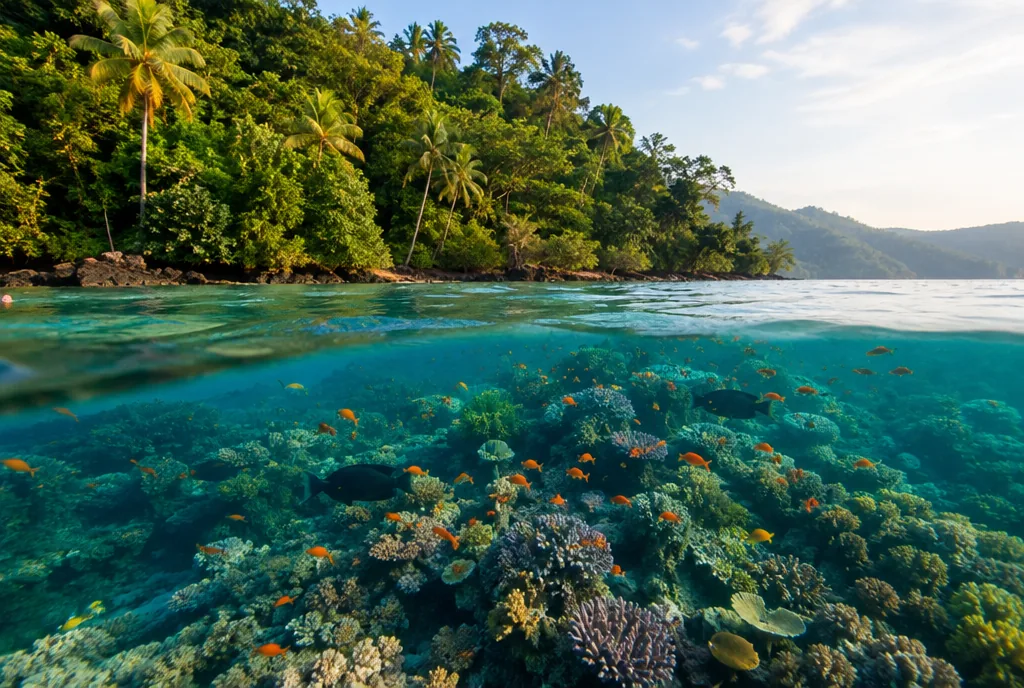
Coral reefs are among the most productive and biologically diverse aquatic environments. Their complex physical structure creates many niches, and abundant light distinguishes them from the deep ocean, where homogeneous topography and lack of light correspond with lower species diversity. This contrast explains the familiar phrase “rainforests of the sea” without reducing reefs to a metaphor.
The Great Barrier Reef is the world’s largest coral reef ecosystem. It spans 14 degrees of latitude, includes more than 2,900 separate reefs and 70 bioregions, and contains deep-water canyons, channels, plateaux, and slopes on the adjoining continental shelf. Its biodiversity includes 1,625 fish species, more than 450 hard coral species, 54% of the world’s mangrove diversity, and about 6,000 km² of seagrass beds. Those figures point to ecosystem diversity as well as species diversity: reef, mangrove, seagrass, and deeper shelf environments occur within one vast system.
Much marine biodiversity remains unknown. The Census of Marine Life estimated more than 1 million marine species, only about 250,000 of which had been described and cataloged. A separate estimate places marine eukaryotic species at 2.2 million, with 91% awaiting description. Even on a familiar coast, observers have only a partial view of ocean life.
Biodiversity hotspots pair exceptional rarity with exceptional loss
A biodiversity hotspot is not simply any place with many species. To qualify, a region must contain at least 1,500 endemic plant species found nowhere else and must already have lost at least 70% of its original natural vegetation. The definition joins biological rarity to habitat loss, directing attention toward places where irreplaceable life and intense pressure meet.
There are 36 recognized hotspots. Together, they cover only 2.5% of Earth’s land surface but support more than half of the world’s endemic plant species and nearly 43% of endemic bird, mammal, reptile, and amphibian species. The Tropical Andes and Sundaland each contain about 15,000 endemic plant species. The North American Coastal Plain, stretching from Cape Cod in Massachusetts to northeastern Mexico, became the 36th hotspot in February 2016.
Hotspots are human places as well as biological ones: around 2 billion people live in them, including many people who rely directly on healthy ecosystems for livelihoods and well-being. Intact habitats in hotspots account for an estimated 35% of the ecosystem services vulnerable human populations depend on. The term therefore does not mean “empty wilderness.” It names regions where biodiversity and human dependence are closely entwined.
Biodiversity loss changes food, health, water, and climate relationships
The 2019 IPBES Global Assessment found that around 1 million animal and plant species are threatened with extinction, many within decades. Current extinction rates are 10 to 100 times higher than the average natural baseline over the past 10 million years. The five direct drivers are changes in land and sea use, direct exploitation of organisms, climate change, pollution, and invasive alien species.
The scale of change is broad: 75% of Earth’s land surface has been significantly altered by human actions, 66% of the ocean area experiences increasing cumulative impacts, and more than 85% of wetlands have been lost. More than 40% of amphibian species, almost 33% of corals, and more than a third of marine mammals are threatened with extinction. Invasive alien species contribute to 60% of species extinctions and cause US$423 billion in global economic damage each year.
Why is biodiversity important to daily life? More than 75% of global food crops rely on animal pollinators, contributing US$235–577 billion annually to agricultural output. More than half of modern medicines derive from natural sources; penicillin comes from Penicillium, and Taxol was discovered in the bark of Pacific yew trees. Forests store 80% of terrestrial biodiversity and absorb about 2.6 billion tonnes of CO₂ annually. Healthy ecosystems provide 75% of global freshwater resources, while wetlands help purify water.
Common misunderstandings hide the real biodiversity problem
- “Biodiversity means tropical wildlife.” Tropical rainforests and coral reefs offer dramatic examples, but biodiversity includes deserts, grasslands, tundra, wetlands, and the deep ocean. Grasslands and prairies occupy about 20% of Earth’s land surface and are shaped by seasonal drought, fire, and grazing.
- “More species always tells the whole story.” Species richness matters, but evenness matters too. Genetic diversity within a species and ecosystem diversity across habitats reveal different forms of vulnerability or resilience.
- “A hotspot is a protected paradise.” A hotspot must have already lost at least 70% of its original natural vegetation. Its designation identifies urgency, not safety.
- “Biodiversity loss affects only wildlife.” Pollination, natural-source medicines, freshwater, and forest carbon absorption connect biodiversity loss to food, health, water, and climate relationships.
Frequently Asked Questions
What are some examples of biodiversity?
Examples include genetic differences among crop varieties, the mix of fish on a coral reef, and the variety of ecosystems in one region. Wheat landraces with alleles for cold tolerance and disease resistance, a reef with 500 fish species, and a landscape containing grassland, wetland, and forest all show different forms of biodiversity.
What are examples of high biodiversity?
The Amazon rainforest and coral reefs are prominent examples. An Amazon hectare can harbor around 310 tree species, while a British temperate-forest hectare may have fewer than 10–15. The Great Barrier Reef contains 1,625 fish species and more than 450 hard coral species.
What are some real-life examples of biodiversity?
Real-life examples include the Florida panther genetic rescue, the Irish Potato Famine’s crop monoculture, the Amazon’s 16,000 estimated tree species, and the North American Coastal Plain biodiversity hotspot. Each highlights a different level: genetic, species, or ecosystem diversity.
What are the three types of biodiversity?
The three types are genetic diversity within a species, species diversity measured through richness and evenness, and ecosystem diversity across habitats, communities, and ecological processes.
Why is biodiversity important?
Biodiversity supports pollination, medicines, freshwater, and climate relationships. More than 75% of global food crops rely on animal pollinators, and more than half of modern medicines come from natural sources.