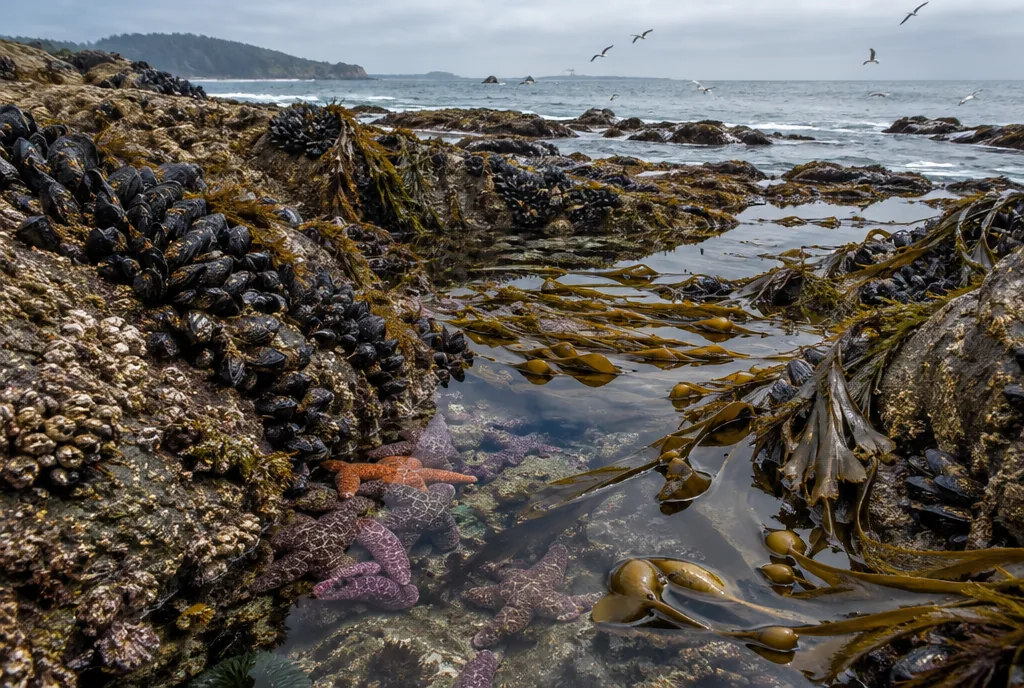
Community ecology is the study of how two or more species interact while sharing a habitat, and of how those interactions shape which species persist together. It begins with a deceptively simple question: why can some species live side by side in the same place while others cannot? The answer may lie in a mussel bed on Washington’s coast, a forest food web, the slopes of a volcano after an eruption, or a partnership between people and birds.
A community is more than the place where species live
In ecology, a community is the full set of populations of different species living in the same place at the same time and interacting with one another. Those populations are connected through food webs, competition, and facilitation. A habitat, by contrast, names the physical place. On a rocky shore, the sea stars, mussels, barnacles, and other organisms whose lives intersect make up a community.
That distinction also separates community ecology from population ecology. Population ecology focuses on a single species. Community ecology follows several associated species in a region and asks how each changes the occurrence and abundance of the others. The German zoologist Karl Möbius coined the older term biocenosis in 1877, an early predecessor of this idea of a living community.
At the center is coexistence. To explain it, community ecologists examine competition, predation, parasitism, and mutual help, each of which can alter which species are present, how common they are, and how the whole assemblage changes over time.
How species interactions shape a community
Interactions between species form a web of effects. One interaction rarely stays isolated: a change involving one species can affect many others. Ecologists use five broad interaction types as a starting map.
| Interaction | Effect on the species | What it means | Example |
|---|---|---|---|
| Mutualism | Both benefit | Each participant gains from the relationship. | In pollination, an animal receives nectar while a plant receives gamete transfer. |
| Commensalism | One benefits; one is unaffected | One species gains without helping or harming the other. | Barnacles on whales gain transport and access to food particles; the whale is neither harmed nor helped. |
| Competition | Both are negatively affected | Species draw on the same limited resource. | Two species using the same limiting resource constrain one another. |
| Predation or herbivory | One gains; one loses | A consumer benefits while prey or a plant is harmed. | Pisaster sea stars consume mussels. |
| Parasitism | One gains; one loses | A parasite benefits at the expense of its host. | The common cuckoo lays eggs in the nests of other bird species. |
These labels make a complex community easier to examine, but they are not a scorecard for deciding whether a community is “good” or “bad.” Competition can limit coexistence. Predation can keep a single competitor from taking over. Mutualism can link organisms with very different ways of life. In each case, the ecological question is what the interaction changes in this particular community.
Competition reveals the difference between a habitat and a niche
When two species depend on the same limited resource, competition negatively affects both. The competitive exclusion principle, associated with Gause in 1934, states that two species with identical ecological niches cannot coexist indefinitely. A niche is more than a location: it includes the conditions, resources, tolerance ranges, and interactions that allow a species to survive and reproduce.
For this reason, ecologists distinguish a fundamental niche from a realized niche. The fundamental niche is the theoretical range a species could occupy without biological restrictions. The realized niche is the portion it actually occupies in the presence of competition and predation. Knowing a habitat therefore does not fully explain a species’ role in a community.
Joseph Connell’s 1961 work with two barnacle species on Scottish shores made the distinction concrete. Chthamalus stellatus could live lower in the intertidal zone as part of its fundamental niche, but competition with Semibalanus balanoides restricted it to the upper area. On one shoreline, a physical gradient and an interaction together decide where a species actually occurs.
Food webs show why one interaction can travel far
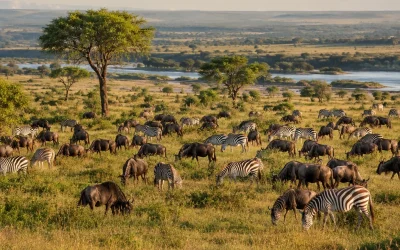
A food web is the natural linkage of food chains within an ecological community: a picture of who eats whom. In 1927, Charles Elton introduced the concepts of trophic levels and food chains, giving ecologists a way to trace energy through those links. Apex predators sit at the top trophic level; no other species kills them for food.
According to the often-used 10 percent rule, associated with Lindeman’s 1942 work, only about 10 percent of the energy at one trophic level passes to the next. Every feeding link therefore matters. A food web is more than a list of diets; it is the structure through which effects move between species.
The snowshoe hare and the Canada lynx offer a long-running example. Hudson’s Bay Company fur records documented their cycles for more than 200 years, and an analysis of records from 1821 to 1910 found a period of 9.6 years. These cycles are among the best-known predator-prey patterns. They show why community ecology looks at changing relationships rather than treating a species’ abundance as an isolated fact.
Keystone species can rearrange an entire shoreline
A keystone species has an influence on its environment that is disproportionately large relative to its abundance. Robert T. Paine introduced the term in 1969. The idea shifts attention away from simple head counts: a species need not be the most abundant member of a community to have the largest structural effect.
Paine’s 1966 experiment at Mukkaw Bay, Washington, became the classic demonstration. He removed the sea star Pisaster ochraceus from a rocky shore. After two years, the California mussel Mytilus californianus dominated the area, and diversity among the remaining primary space occupiers fell from more than 15 species to only a few. By eating mussels, Pisaster had kept a strong competitor in check.
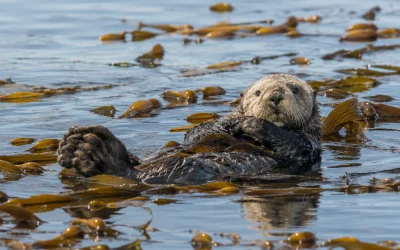
Context matters here. At wave-exposed sites, Pisaster can be a strong keystone predator; in protected locations, including Alaskan sites where it does not preferentially eat Mytilus, it may be just another sea star. Sea otters are a second example: by eating sea urchins, they protect kelp forests from overgrazing. Not every predator is a keystone species everywhere, but particular links can hold a community’s structure in place.
Species richness and evenness answer different diversity questions
Species richness is the number of different species in a community. Species evenness describes how evenly individuals are distributed among those species. A community with many species can still have low evenness when a few of them dominate. Another community with the same number of species can have higher evenness when abundances are more similar.
Counting species alone therefore does not reveal the full pattern of diversity. The Shannon diversity index, written H′, and the Simpson diversity index are the most commonly used measures that combine richness and evenness in one value. Pielou’s evenness index, J′, is defined as H′/ln(S); it compares the observed Shannon value with the maximum possible value for a given number of species.
In community ecology, these measures describe the outcome of interactions. After a predator is removed and mussels take over the available space, the question is not just whether any other species remain. It is also how strongly one species now outweighs the rest.
Succession and disturbance keep communities in motion
Ecological succession is the directional, often predictable change in a community’s species composition over time. Communities are connected by present interactions, but they also have histories: which species arrived, persisted, altered conditions, or made room for others all shape the assemblage.
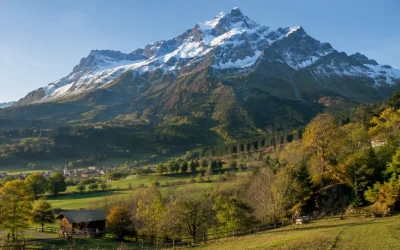
Primary succession begins on a surface without vegetation, soil, or seed bank, such as bare rock, lava flows, or newly exposed ground in front of glaciers. It typically takes 500 to 1,000 years to reach a climax forest. Secondary succession begins where soil, a seed bank, roots, and organic material have largely remained, for example after fire, clear-cutting, or flooding. It typically takes 100 to 200 years.
The 1980 eruption of Mount St. Helens is a well-documented example of primary succession. More generally, succession may proceed through facilitation, in which one species prepares conditions for the next; inhibition, in which one blocks potential successors; or tolerance, in which later species endure conditions and compete successfully. Frederic Clements divided succession into six phases: nudation, migration, ecesis, competition, reaction, and stabilization.
Disturbance is part of this story, not simply an interruption. Fire, clear-cutting, floods, land-use change, volcanic eruptions, and glacier retreat release light, water, and nutrients and create room for new species. Connell’s 1978 intermediate-disturbance hypothesis holds that diversity is highest at intermediate disturbance frequency: too little disturbance favors competitive exclusion, while too much removes sensitive species.
Human relationships can also belong in the ecological picture
Community ecology can include interactions in which people take part. A striking example is the relationship between the Boran people in Africa and the honey guide, a bird. The bird leads people to bee colonies, and both benefit; this partnership is reported to go back more than 20,000 years. The mutualism makes the usual “species interaction” diagram less abstract: a community can include relationships that cross the assumed boundary between human life and other species.
This example does not make every contact between humans and animals mutualistic. It does supply a disciplined question: what does each participant do, who benefits or loses, and how does that relationship affect the larger set of species in a shared place?
Four common mistakes that blur the picture
Myth: A habitat and a community are the same thing
A habitat is the physical setting. A community is the set of interacting populations of different species within that setting. Calling a forest a community without naming those relationships leaves out what makes the concept useful.
Myth: More species always means a more even community
Richness counts species; evenness describes their relative abundances. A community rich in species can still be dominated by one or a few of them.
Myth: Community ecology is only about competition
Competition is one force, not the whole field. Predation, herbivory, parasitism, mutualism, commensalism, facilitation, food webs, and disturbance also shape community composition.
Myth: A keystone species has the same effect everywhere
Pisaster shows why this is wrong. Its effect differs between wave-exposed and protected locations. Keystone status describes a relationship in a given context, not a permanent rank a species carries into every habitat.
Frequently Asked Questions
What is community ecology?
Community ecology examines interactions among two or more species that share a habitat. Unlike population ecology, it considers multiple associated species and asks how their relationships shape the community.
What is an example of community ecology?
Paine’s removal of Pisaster ochraceus from a Washington rocky shore is a classic example. Mussels then dominated the area and diversity declined, showing how predation can shape an entire community.
What is the main focus of community ecology?
Its main focus is why species coexist or fail to coexist, and how competition, predation, parasitism, mutualism, and other interactions determine community composition and abundance.
What is a community in ecology?
A community is all the populations of different species living in the same place at the same time and interacting through connections such as food webs, competition, and facilitation.