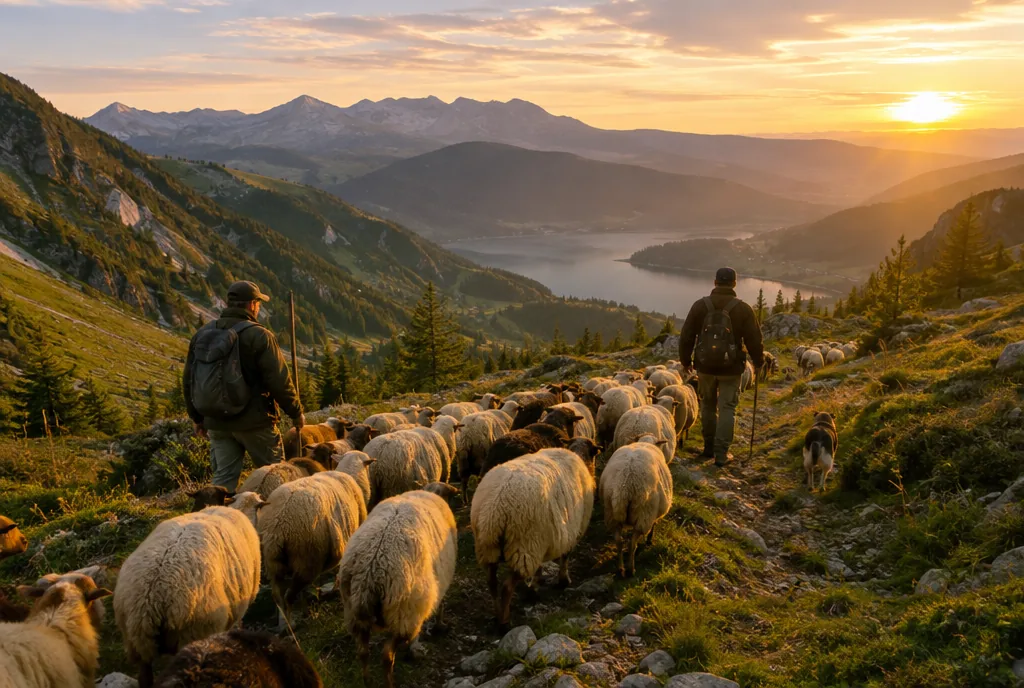
The transhumance definition in AP Human Geography is simple but precise: it is the seasonal movement of livestock between fixed pastures, usually at different elevations. The pattern is more than a trip with animals. A herd and a small group of herders leave a permanent community to use a pasture when it is productive, then return on a predictable seasonal schedule. That arrangement reveals how people turn changing grass, water, temperature, and terrain into a workable agricultural system.
What transhumance means on the ground
Transhumance is a form of mobile pastoralism: a way of life based on livestock rather than crop cultivation. At its center is seasonal movement between established grazing areas. One pasture is used in summer and another in winter, allowing herds to use different ecological zones when forage is available and avoid concentrating grazing pressure on one place.
The word comes through French from Latin roots meaning, literally, crossing the land. Yet transhumance is not aimless movement across an open landscape. Its routes, seasonal pastures, and timing are known in advance. The community has a permanent base, while only the animals and a limited number of herders travel. That division of labor separates transhumance from systems in which an entire community moves with its animals.
Transhumance developed independently on every inhabited continent, and it takes different forms because environments differ. In mountains, elevation may be the decisive change. Across plains and drylands, latitude, rainfall, or the contrast between dry-season and rainy-season forage can set the pattern.
How seasonal herding follows productive pasture
A transhumant calendar follows the changing capacity of the land to feed animals. Two moves a year are common: herds leave winter pasture for summer pasture, then return before the next winter. Rather than asking one range to support animals all year, this rotation uses each area in its productive season.
Vertical transhumance moves up and down
In the classic mountain pattern, vertical transhumance changes elevation. In summer, animals climb to high pastures when mountain meadows are productive, then descend to valleys in winter. Different elevation zones are linked, each with its own temperature and growing season. In the Alps, most pastures lie below 2,400 meters, and all lie below 2,800 meters.
Horizontal transhumance moves across the landscape
Horizontal transhumance moves the herd across plains or between latitudes. Depending on the season, it may shift between colder northern and warmer southern plains. As in a mountain system, winter and summer pastures are distinct, and conditions determine the movement between them. The route runs horizontally rather than uphill and downhill.
- Fixed seasonal pastures: the herd alternates between known grazing areas rather than roaming without a set seasonal pattern.
- Predictable timing: movements follow the seasonal cycle, often with one trip toward summer pasture and one return toward winter pasture.
- Selective mobility: livestock and a few herders travel, while the rest of the community remains at a permanent settlement.
- Ecological purpose: the system uses productive zones in season and helps avoid overgrazing on any single pasture.
From Alpine pastures to Sahel corridors
The Alps show vertical transhumance at a large scale. Each year in Switzerland, about 380,000 cattle, including 130,000 dairy cows, are driven to alpine summer pastures. The return is not only a logistical change in grazing. In October, herders bring cattle down to the valleys, and decorated cows and descent festivals mark the end of the mountain season. Over centuries, transhumance has shaped the alpine landscape: without it, most areas below 2,000 meters would be completely forested.
In the Pyrenees, cattle, sheep, and horses generally reach mountain pasture in late May or early June and leave in early October. More than 150 kilometers separate winter pastures in the Ebro Valley from mountain puertos on some long-distance routes. These traditional routes are called cabaneras. Around the feast of San Pedro in early July, sheep may be driven upward and return around San Miguel in late September, showing how an agricultural rhythm can also become a social calendar.
In the Sahel of West Africa, the contrast is not mainly mountain and valley. Here, transhumance connects dry-season and rainy-season pasture along centuries-old corridors. Fulani herders travel hundreds of kilometers with cattle between the dry northern Sahel and wetter southern regions to reach water and grazing. In climates too dry for dependable crop agriculture, this mobility is an adaptation. It also exposes a difficult tension: competition between pastoralists and settled farmers over water and pasture is increasing with climate change and population growth.
Transhumance is not pastoral nomadism
Because both systems involve herds and movement, they are easy to confuse. The key difference is the permanent settlement. In transhumance, a community has a durable home base and usually keeps most people there; a small group accompanies the livestock along a recurring seasonal route. Transhumant communities often also farm around those settlements.
Pastoral nomadism works differently. It has no permanent settlement: the whole community moves with its herds throughout the year, and its livelihood depends almost entirely on livestock. The difference matters because it changes where people live, who travels, how work is organized, and how agricultural land is used.
| Question | Transhumance | Pastoral nomadism |
|---|---|---|
| Where is home? | A permanent settlement remains the community base. | There is no permanent settlement. |
| Who moves? | The herd and a small number of herders. | The whole community moves with the herd. |
| What is the pattern? | Predictable seasonal movement between fixed pastures. | Year-round movement with the herd. |
| How is food produced? | Communities often combine herding with cultivation near settlements. | Livelihood depends almost entirely on the herds. |
The transhumance definition in AP Human Geography
For AP Human Geography Unit 5, transhumance makes a broad idea concrete: the physical environment shapes agricultural practice. As extensive subsistence agriculture, pastoralism uses large areas of land with relatively little labor per hectare. In arid, semi-arid, and high-mountain settings, reliable crop farming may be difficult. Instead, seasonal herding makes use of pasture that becomes productive at different times.
On an AP question, start with the settlement pattern. If the prompt describes livestock moving seasonally between fixed winter and summer pastures while a permanent village remains in place, it describes transhumance. If the entire group moves with the animals and lacks a permanent settlement, it describes pastoral nomadism. That contrast is a frequent exam trap, but it is also a direct way to explain human adaptation to place.
Why a seasonal practice carries cultural weight
Transhumance is an economic practice, but it also preserves routes, seasonal knowledge, local food production, and community rituals. UNESCO added “Transhumance, the seasonal droving of livestock” to its Representative List of the Intangible Cultural Heritage of Humanity in December 2023. The inscription covers Albania, Andorra, Austria, Croatia, France, Greece, Italy, Luxembourg, Romania, and Spain.
According to UNESCO, the practice strengthens cultural identity and social bonds, helps keep rural areas populated, and preserves biodiversity. The scale of the landscape record can be striking. Spain has about 125,000 kilometers of droving routes across the Iberian Peninsula, while ancient sheep tracks in Italy’s Abruzzo can be up to 100 meters wide. They show how deeply the practice has marked the land.
Common myths hide how the system works
Myth: Everyone in a transhumant community migrates
In transhumance, only livestock and a small number of herders move. Other community members remain in the permanent settlement. Moving people and moving herds are therefore not the same social process.
Myth: Transhumance is just another name for nomadic herding
Both are forms of pastoralism, but transhumance has a fixed base and regular seasonal pastures. Pastoral nomadism involves the movement of the whole community without a permanent settlement.
Myth: It happens only in mountains
Mountain systems are prominent examples, but horizontal transhumance also occurs across plains and drylands. The Sahelian movement between dry-season and rainy-season grazing areas shows why elevation is not required.
Myth: It is only a relic of the past
Industrialization has displaced transhumance in many places, yet local systems continue in mountain, tundra, and semi-arid zones where machinery is not economically practical. In Europe, rural outmigration, demanding work, low profitability, and too few herders contribute to decline; continuation and pressure can exist at the same time.
A seasonal system tested by climate and winter
Beyond Europe, Mongolia demonstrates the stakes of seasonal mobility. Its 2025 livestock census counted 58.1 million animals. Seasonal movement helps nomadic herders prepare for dzud, a winter disaster that can kill millions of animals. At winter camps, herders may form groups of six to eight small families and join larger groups again in summer. There, mobility is not a decorative tradition; it is part of how herds are managed through severe conditions, including winter temperatures that can fall below minus 40 degrees Celsius.
Across regions, transhumance shows that mobility can be a disciplined response to environmental variation. Its routes are shaped by pasture, water, season, labor, and settlement. That is why the practice belongs in cultural ecology as well as in agricultural geography.
Frequently Asked Questions
What is transhumance?
Transhumance is the seasonal movement of livestock between fixed pastures. A small number of herders travel with the animals, while the larger community remains in a permanent settlement.
What is an example of transhumance?
In the Swiss Alps, cattle move to alpine summer pastures and return to valleys in October. In the Pyrenees, some herds travel more than 150 kilometers between Ebro Valley winter pastures and mountain grazing areas.
What is the difference between transhumance and pastoral nomadism?
Transhumance has a permanent community base and predictable seasonal movement between fixed pastures. In pastoral nomadism, the whole community moves with the herd and has no permanent settlement.
Why does transhumance matter in AP Human Geography?
It is an AP Human Geography Unit 5 example of extensive subsistence agriculture and of the way physical environments shape farming. It also provides a clear contrast with pastoral nomadism.
What is the difference between vertical and horizontal transhumance?
Vertical transhumance moves herds between elevations, such as summer mountains and winter valleys. Horizontal transhumance moves between areas across plains or latitudes, such as colder northern and warmer southern grazing areas.