At its core, food web vs food chain comes down to a line versus a network. A food chain follows energy along one direct route, from grass to grasshopper to frog to snake to eagle. A food web combines many such routes and shows the more realistic situation, in which an animal eats several foods and can itself feed several predators. The chain makes one energy pathway easy to follow; the web shows how the whole community is connected.
Food web vs food chain: one path or the whole community?
In its simplest form, a food chain is a linear sequence of organisms that shows who eats whom. Beginning with a producer such as grass, it can end with a top predator such as a grizzly bear or with decomposers acting on dead material. From the organism being eaten to the organism that eats it, each arrow marks one transfer of energy.
By contrast, the standard food web definition describes a non-linear network of interconnected food chains within an ecosystem. Rather than treating a frog, snake, or eagle as part of only one route, a web can show its many feeding relationships. This distinction matters because most animals have more than one prey species and more than one predator. Real ecosystems are networks, not single-file lines.
| Question | Food chain | Food web |
|---|---|---|
| What does it show? | One direct path of energy transfer. | Many overlapping paths of energy transfer. |
| Shape | A line of feeding relationships. | A network of linked food chains. |
| Best use | Teaching a clear sequence or modeling a simple predator-prey system. | Understanding the complexity of a real community. |
| How accurate is it? | Useful but deliberately simplified. | More realistic because it includes alternate prey and predators. |
For ecologists, neither concept is disposable. A chain isolates one pathway so you can follow each step. A web restores the alternatives that a chain leaves out. In mathematical models, ecologists also use simplified three-species chains, even though those models do not represent every link in a living community.
Every link occupies a trophic level
A trophic level is an organism’s position in a feeding relationship, measured by the number of energy-transfer steps from the base. At that base, producers form organic compounds. On land, plants including grasses, trees, and shrubs use sunlight. In water, algae and single-celled phytoplankton are producers. In hydrothermal areas of Yellowstone Lake, microbes obtain energy from sulfur rather than sunlight.
Consumers move energy upward through the web
After producers come primary consumers, which eat them. Deer, rabbits, grasshoppers, and zooplankton belong here. At the next step, secondary consumers eat primary consumers; frogs, small fish, and spiders are common examples. Above them, tertiary consumers eat secondary consumers, including snakes, foxes, and larger fish. At the highest trophic level are apex predators with no natural predators in that food chain, such as eagles, orcas, and grizzly bears.
Still, these labels are a useful map, not permanent identities. When young, an insect or fish can occupy a lower trophic level than it does as an adult. Within a food web, a species may also feed at more than one level depending on what it eats. For that reason, a web often represents the ecosystem better than a single chain.
Decomposers keep dead material from becoming a dead end
Among decomposers, bacteria and fungi break down dead organic matter and return nutrients to the soil. Through mineralization, complex organic compounds become simple inorganic nutrients that plants can take up again. By contrast, detritivores including earthworms and woodlice eat dead organic particles. Unlike decomposers, they do not chemically break down organic material. With more than 100,000 decomposer species estimated to exist, an ecosystem’s feeding relationships include much more than its visible hunters and prey.
The energy pyramid explains why chains stay short
At a broad base, an energy pyramid places producers; at a narrow peak, it places top predators. Its shape reflects a basic constraint: only about 10 percent of the energy at one trophic level is transferred to the next. Depending on the ecosystem and organisms, actual ecological efficiency commonly ranges from 5 to 20 percent. The energy that does not move upward is used in metabolism or lost through respiration, heat, waste, and dead biomass that is not eaten.
That loss adds up at every level. As a result, food chains rarely extend beyond four or five trophic levels. For people, it also explains why eating plants such as lettuce directly yields more energy per kilogram than eating animals that first ate plants: the animal adds another transfer where much of the earlier energy is no longer available.
Rather than a ranking of importance, the pyramid is an energy diagram. Producers, consumers, detritivores, and decomposers all take part in the system. It shows why a relatively small number of apex predators depends on energy entering through a much larger producer base.
Five food chain examples make the pattern visible
Across grasslands, lakes, oceans, and places without sunlight, the same basic pattern appears. Read each arrow as “energy moves from this organism to the organism that eats it.”
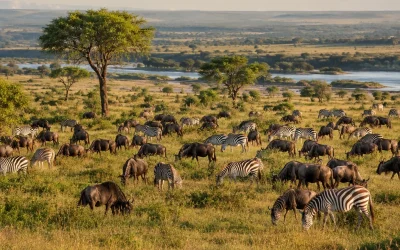
- Grassland: grass → grasshopper → frog → snake → eagle.
- Meadow: clover → snail → frog → snake.
- Marine: phytoplankton → zooplankton → small fish → tuna → shark.
- Swedish lake: crustaceans → bleak → perch → pike → osprey.
- Deep sea: chemosynthetic bacteria using hydrogen sulfide → tube worms → deep-sea shrimp → squid.
Taken alone, each example is a chain, not a claim that the organisms eat only the species named beside them. For instance, the marine example is one route through a larger marine food web. A network would add the other organisms that eat phytoplankton, zooplankton, fish, tuna, or shark, plus the organisms that consume their remains.
Keystone species can change an entire food web
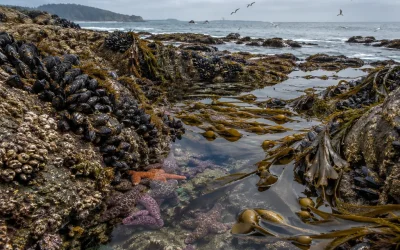
Ecologists use the term keystone species for an organism whose influence is so large that, without it, the system can collapse or change fundamentally. Ecologist Robert T. Paine coined the term in 1969, naming it after the keystone that holds an arch together. On a rocky Washington coast, his field experiment made the concept concrete: after he removed the sea star Pisaster ochraceus, the mussel Mytilus californianus came to dominate the area and biodiversity declined.
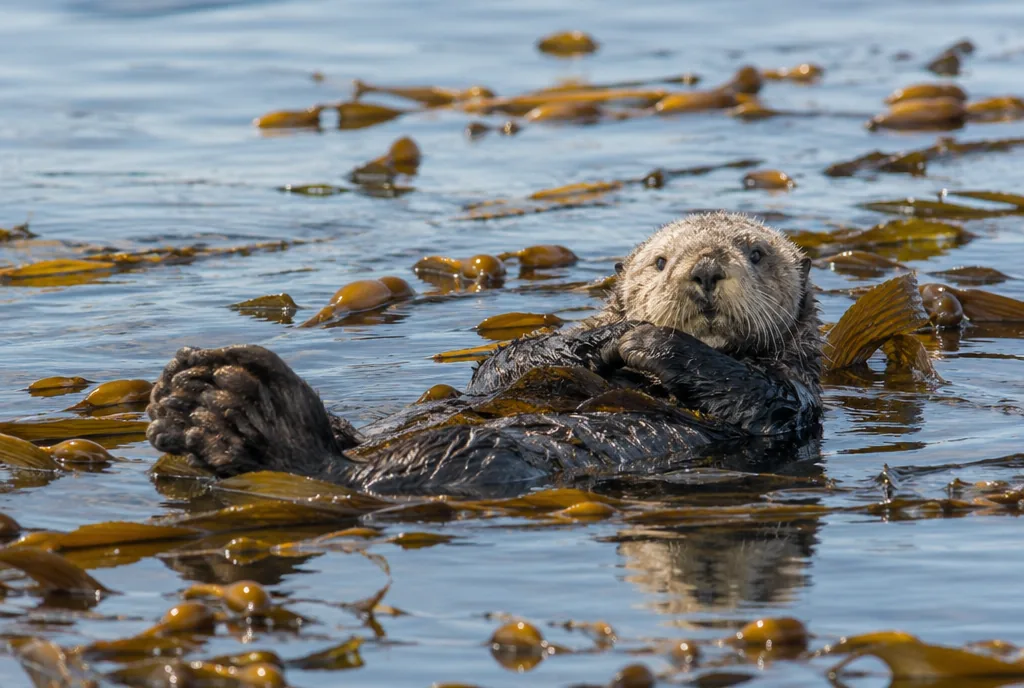
In the North Pacific, sea otters offer another web-level example. By eating sea urchins, they keep urchin numbers in check. Without otters, urchins can destroy kelp forests and the community that depends on them. Removing one relationship can rearrange many others, including habitat and opportunities for other species.
Yellowstone wolves show a trophic cascade in action
When an apex predator is added or removed, its effects across several trophic levels are called a trophic cascade. In January 1995 and 1996, gray wolves were reintroduced to Yellowstone National Park’s Lamar Valley after being eliminated from the park in 1926. Two years after their return, coyote numbers in affected areas had fallen to 50 percent of their pre-wolf level through competition and direct killing by wolves.
With the wolves’ return came a broader cascade: fewer elk browsing on young plants supported regrowth along stream banks, beaver populations grew, and river courses changed. At least 12 species, including ravens, wolverines, bald eagles, golden eagles, and grizzly bears, also used wolf carcasses as food. Whereas a food chain can show wolf → carcass consumer, a food web reveals how many species meet at that resource and how effects can travel through the community.
Marine food webs begin with tiny producers
In the ocean, a marine food web often begins with phytoplankton, single-celled algae and plant-like organisms that photosynthesize. Together, phytoplankton account for about half of global carbon fixation and oxygen production. Zooplankton, tiny animals such as copepods, eat phytoplankton and form the key link between producers and the rest of marine life.
Much of the web is easy to miss. In the microbial loop, bacteria convert dissolved organic matter into particles that zooplankton can eat, returning that material to the web. Far below the reach of sunlight, bacteria and archaea at hydrothermal vents and cold seeps use chemosynthesis, drawing energy from hydrogen sulfide. They show that the producer base of a food web does not always depend on sunlight.
Climate change adds pressure. At higher temperatures, the transfer of energy from producers to higher trophic levels declines, simplifying the marine food web. Although a single chain cannot show every consequence, it can help identify the transfers that a changing web depends on.
Teach the web, then correct the common myths
To introduce the idea to a child, start with a “who-eats-whom” map. Begin with the sun → plant → rabbit → fox as one straight food chain. Then add mice and birds that the fox also eats. Several lines now meet at the fox, turning the simple chain into a food web. The spiderweb comparison works because it puts the focus on connections: many lines cross and meet.
Four misconceptions that blur the picture
- “Arrows point to what gets eaten.” In standard food-web diagrams, arrows point from the eaten organism to the eater because they show the direction of energy flow.
- “A top predator is independent.” Far below an eagle or wolf, producers supply the energy on which it still depends.
- “Dead material is outside the web.” Through decomposers and detritivores, dead matter connects back to nutrients and living organisms.
- “Every organism has one fixed trophic level.” As diets change, young animals may feed at a lower level than adults of the same species.
Frequently Asked Questions
What is the difference between a food chain and a food web?
A food chain shows energy transfer along one linear path. A food web combines many chains and shows the overlapping feeding relationships in an ecosystem.
What are examples of food chains?
On land, grass → grasshopper → frog → snake → eagle is one example. In the ocean, phytoplankton → zooplankton → small fish → tuna → shark is another.
Which is more accurate, a food chain or a food web?
For a real ecosystem, a food web is more accurate because most organisms have multiple prey and predators. When one energy pathway needs to be explained clearly, a food chain remains useful.
How do you explain a food web to kids?
Start by calling a food chain a straight line showing who eats whom. Then add the different foods eaten by the fox, rabbit, or bird; the crossing lines create a web.
Why do arrows point from food to the eater?
Every arrow follows the energy. When a grasshopper eats grass, energy moves from the grass to the grasshopper, so the arrow points toward the grasshopper.