What is a biome? It is a large geographic region whose climate, vegetation, animal life, and adapted ecosystems form a recognizable pattern. A biome is much bigger than one pond, forest stand, or animal’s home: it can stretch across continents and hold many distinct ecosystems. From a treeless Arctic plain to a rainforest canopy, learning to read biomes turns a map of climates and plants into a map of living possibilities.
What a biome means—and what it does not
The biome meaning begins with broad environmental conditions. In any region, temperature, precipitation, soils, and water availability shape which plants can grow, and those plants shape the conditions for animals and other organisms. A biome is therefore best described as a large area characterized by its vegetation, soil, climate, and animal life. It is also often called a life zone, a term that emphasizes organisms and their adaptations.
Three terms are easy to confuse. A habitat is the particular place where one species lives. An ecosystem is a community of organisms interacting with its physical environment. A biome includes many ecosystems and habitats. In a freshwater biome, for example, a pond can be both an ecosystem and a habitat.
The word biome comes from the Greek bios, meaning life. U.S. ecologist Frederic Clements introduced it to scientific language in 1916. In 1935, Arthur Tansley introduced the related term ecosystem. From 1964 to 1974, the International Biological Program helped make the biome concept widely used.
Climate and vegetation make the world’s broad living patterns
Climate and vegetation are the starting points for identifying different biomes. Whittaker’s 1975 framework uses annual precipitation and mean annual temperature as two axes and links each climate to a characteristic biome. Holdridge’s life-zone classification uses three dimensions: precipitation, temperature, and evapotranspiration. Both approaches show why a label such as “forest” is not enough on its own. A boreal forest, a temperate forest, and a tropical rainforest stand for very different combinations of climate and vegetation.
Precipitation and water availability drive aboveground primary production, while sunlight and temperature influence belowground production in roots. Biome edges are rarely hard lines. Between two biomes lies a transition zone called an ecotone. At the tree line, also called the timberline, tundra changes into taiga as trees fade out rather than stopping at a perfectly drawn boundary.
For map readers, this gradual change is a useful reminder. Biome maps simplify broad patterns; they do not claim that every square mile on one side of a boundary is identical to every square mile on the other.
Terrestrial and aquatic biomes organize life at different scales
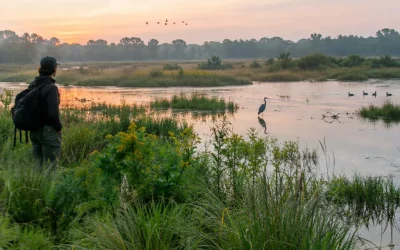
At a broad scale, five major biome types are recognized: aquatic, grassland, forest, desert, and tundra. Each contains more specific terrestrial or aquatic biomes. Freshwater biomes have a salinity below 1 percent; ponds, rivers, and lakes are examples. Marine biomes include oceans, coral reefs, and estuaries.
On land, major groups include tundra, taiga, temperate forest, tropical rainforest, grassland, savanna, and desert. These labels are useful for comparison, but they are not a single universal checklist. Forests contain most of Earth’s terrestrial biodiversity, while deserts have comparatively low biodiversity.
| Biome or group | Defining pattern | Concrete example or feature |
|---|---|---|
| Freshwater | Salinity below 1 percent | Ponds, rivers, and lakes |
| Marine | Ocean-based aquatic systems | Oceans, coral reefs, and estuaries |
| Tundra | Treeless land with permafrost | Dwarf shrubs, mosses, and lichens |
| Taiga | Conifer-dominated boreal forest | A belt from 50°N to 70°N |
| Savanna | Grasses with widely spaced trees | An open canopy lets grass persist below |
| Desert | Less than 50 cm of rain yearly | Hot, cold, coastal, and semiarid forms |
Tundra and taiga reveal how a few degrees reshape a landscape
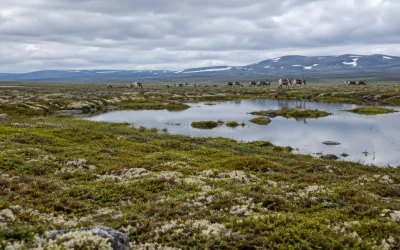
A tundra biome is treeless and has permafrost soil. It occurs in Arctic, alpine, and Antarctic regions. In summer, only the upper 25 to 90 centimeters of soil thaws; below it, permafrost stays frozen throughout the year. Dwarf shrubs, sedges, grasses, mosses, and lichens grow in this thin thawed layer. Individual trees appear only near the tree line.
Arctic tundra has two main seasons: a long, dark winter that can reach −50°C and a short summer of 0°C to 10°C with round-the-clock sunlight. Below the surface, permafrost holds large quantities of dead organic material as methane and carbon dioxide. As warming thaws the ground, those greenhouse gases are released. Nomadic reindeer-herding peoples of the polar tundra include the Nganasan and Nenets in Russia and the Sami in Scandinavia.
South of much of the tundra lies the taiga, or boreal forest, the largest terrestrial biome at about 17 million square kilometers. It forms a broad ring around the Northern Hemisphere between 50°N and 70°N. Pines, spruces, and larches give the taiga its coniferous character. Yet the forest is not uniform: North American taiga is mainly spruce, Scandinavian and Finnish taiga mixes spruce, pine, and birch, while eastern Siberia contains immense larch forests. Boreal forest accounts for 33 percent of global forest area.
The temperate forest biome shows why “forest” has several meanings
The temperate forest biome covers 25 percent of global forest area; only the boreal forest, at 33 percent, is larger. Temperate forests occur in both hemispheres between 25° and 50° latitude. Their main forms are deciduous forest, coniferous forest, mixed forest, and temperate rainforest.
In deciduous temperate forests, trees such as maples and oaks shed their leaves in fall. Temperate rainforests are the wettest type, although most outside protected areas have been logged and no longer exist. In Tasmania, some pines in temperate rainforests can live for more than 2,000 years. These contrasts show that a biome name identifies a broad pattern, while the vegetation within that pattern still carries regional history and variation.
Grasslands and the savannah biome are shaped by openness
Grasslands are ecosystems dominated by grasses, and they occur naturally on every continent except Antarctica. Tropical grasslands near the equator are savannas. Temperate grasslands include the prairies of North America, the steppes of Eurasia, and the pampas of South America. Prairies have taller grasses than steppes. Temperate grasslands receive 25 to 75 centimeters of precipitation per year, less than savannas. Fire and grazing maintain their vegetation; without them, many temperate grasslands would become forests.
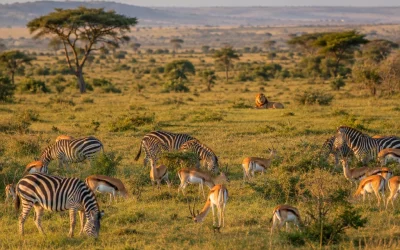
The savannah biome is not simply a treeless plain. It combines grassland with scattered trees whose crowns do not meet, so enough light reaches the ground for a continuous grass layer. Savannas cover about 20 percent of Earth’s land area, mainly in Africa, Australia, South America’s Cerrado, and India. Most rain falls in a single rainy season, and the dry season can last for months; unlike prairies, savannas remain warm to hot year-round.
There are four savanna forms: woodland savanna with light tree cover, tree savanna with scattered trees, shrub savanna, and nearly treeless grass savanna. In the Cerrado, tree density can range from 800 to 3,300 trees per hectare, higher than the 800 to 2,000 trees per hectare reported for neighboring tropical forests. Openness, then, is about canopy structure and light at ground level, not the absence of all trees.
Deserts and rainforests show opposite water limits
A desert receives less than 50 centimeters, or 20 inches, of precipitation a year. Deserts cover about 20 percent of Earth’s surface. The four categories are hot and dry, semiarid, coastal, and cold deserts. A desert is not automatically hot: polar regions count as cold or polar deserts, and about one-third of Earth’s land is arid or semiarid.
To cope with water scarcity, desert plants have small or absent leaves, water-repellent cuticles, spines, and deep roots that can reach groundwater. To avoid daytime heat, many animals are nocturnal, sheltering below ground or in shade and obtaining much of their water from food. Wind sorts desert soils: fine sands form dunes, while coarser stones remain as desert pavement.
Tropical rainforests sit at the other extreme. They cover only about 6 percent of land but hold more than half of the world’s known plant and animal species. They receive at least 200 centimeters of rain a year, some areas more than 1,090 centimeters (430 inches), and temperatures remain between 22°C and 34°C year-round. At roughly 6 million square kilometers, the Amazon is the largest tropical rainforest.
Abundant rain does not mean rich soil. Tropical rainforest soils are acidic and nutrient-poor because decomposition is rapid and nutrients are held in living plant material rather than the ground. A single tree in the dense canopy transpires about 760 liters of water each year; in the Amazon, transpiration and evaporation produce up to 75 percent of its rainfall. Water moves through vegetation, atmosphere, and soil as part of the biome’s defining pattern.
Biomes are living places, not empty background scenery
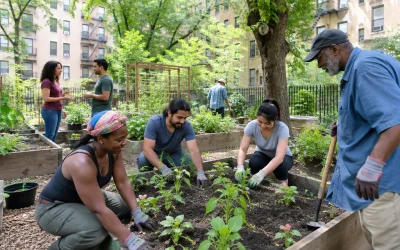
Biomes provide a useful lens for cultural ecology because they connect climate, vegetation, animals, and the conditions in which people live. The tundra example is concrete: its seasonal light, permafrost, and low-growing vegetation form the setting for reindeer-herding peoples such as the Sami, Nenets, and Nganasan. A biome is not a complete explanation of any community, but it makes environmental constraints and possibilities visible.
The numbers are large. Forests cover about one-third of Earth’s land, contain two-thirds of the leaf area of all land plants, and store roughly 70 percent of carbon in living things. The largest biome overall is the marine biome: oceans cover about 71 percent of Earth’s surface. Comparing biomes links local observations—a grass layer, a frozen soil, a seasonal rain—to planetary patterns.
Four misconceptions that hide what biomes really are
- “A biome is the same as a habitat.” A habitat is the specific place of a species; a biome is a continental-scale life zone that includes many habitats and ecosystems.
- “Biome borders are sharp.” Transition zones, or ecotones, connect biomes. The tree line between tundra and taiga is one example.
- “Every desert is hot.” Cold deserts and polar deserts are deserts because of low precipitation, not because of high temperature.
- “A savanna has no trees.” A savanna has widely spaced trees and an open canopy, allowing a continuous layer of grass below.
Frequently Asked Questions
What is a biome?
A biome is a large geographic region defined by characteristic climate, vegetation, animal life, and adapted ecosystems. It contains many ecosystems rather than one single ecosystem.
Which of these best describes a biome?
The best description is a large life zone characterized by vegetation, soil, climate, and animal life. It can extend across continents and is larger than a habitat or individual ecosystem.
What is the biggest biome on Earth?
The marine biome is the biggest overall because oceans cover about 71 percent of Earth’s surface. The taiga, at about 17 million square kilometers, is the largest terrestrial biome.
What is another word for biome?
Life zone is a common alternative term. Scientific writing may also refer to broad-scale ecosystems or ecozones, but a biome is not the same as a species’ habitat.
What is a tundra biome?
Tundra is a treeless biome with permafrost soil in Arctic, alpine, and Antarctic regions. Its vegetation includes dwarf shrubs, sedges, grasses, mosses, and lichens, and only the upper soil layer thaws in summer.