Cultural ecology asks how belief systems shape the way people use land, water and animals. Few belief systems are as influential as the world religions, which together count several billion adherents and own large amounts of land, buildings and investment capital. Since the 1960s a movement has grown that reads environmental care as a religious duty. It has its own theology, its own institutions and, increasingly, measurable projects on the ground.
The starting point: a critique of religion
The modern debate began with an accusation. In 1967 the historian Lynn White Jr. published “The Historical Roots of Our Ecologic Crisis” in the journal Science. He argued that Western Christianity, by placing humans above nature and granting them dominion over it, had helped create the attitudes behind the environmental crisis. The essay became one of the most cited texts in environmental studies.
White did not reject religion; he proposed Francis of Assisi, who preached to birds and called the sun his brother, as a patron saint of ecology. His argument provoked theologians in many traditions to reexamine their scriptures and practices and to recover teachings about restraint, gratitude and responsibility toward creation.
From stewardship to creation care
The idea that humans are stewards of creation rather than its owners appears in Jewish, Christian and Islamic thought. In the Hebrew Bible, the land is described as belonging to God, and laws such as the sabbatical year, when fields were to lie fallow every seventh year, limit human exploitation. In the 1970s and 1980s theologians began to use these ideas explicitly against pollution and resource depletion.
The World Council of Churches adopted “Justice, Peace and the Integrity of Creation” as a program at its assembly in Vancouver in 1983. Ecumenical Patriarch Bartholomew of Constantinople, sometimes called the “Green Patriarch,” has described environmental destruction as a sin since the 1990s. Evangelical groups in the United States formed creation care networks. In academia, the Forum on Religion and Ecology at Yale, founded by Mary Evelyn Tucker and John Grim after a series of conferences at Harvard in the late 1990s, documented environmental teachings across the world’s religions.
Laudato si’
The Roman Catholic Church’s most visible contribution is Pope Francis’s 2015 encyclical Laudato si’, subtitled “On Care for Our Common Home.” It frames climate change, pollution and biodiversity loss as moral questions, links them to poverty and calls for an “integral ecology” that treats social and environmental problems together. Published months before the Paris climate conference, it was widely cited in negotiations. In 2023 Francis followed with the apostolic exhortation Laudate Deum, which criticized the slow pace of climate action.
Beyond the churches
Islam
Islamic teaching describes humans as khalifa, trustees on earth, and warns against waste. In August 2015 Muslim scholars and leaders issued the Islamic Declaration on Global Climate Change in Istanbul, calling on the world’s Muslims to reduce emissions and on wealthy nations to phase out fossil fuels. “Green mosque” programs in Indonesia, Morocco and elsewhere have installed solar panels and water-saving systems on mosques, and some Islamic scholars have supported the protection of hima, traditional reserves for grazing and water.
Hinduism, Buddhism and Jainism
Hindu, Buddhist and Jain teachers draw on doctrines of non-harm (ahimsa) and on the sacredness of rivers, mountains and trees. The Chipko movement in the Himalayan foothills of Uttarakhand, which began in 1973, saw villagers, many of them women, embrace trees to prevent logging; it drew on both livelihood concerns and religious respect for forests. In 2017 the High Court of Uttarakhand declared the Ganga and Yamuna rivers legal persons, although the Supreme Court of India stayed the ruling a few months later.
In Thailand, Buddhist monks have ordained trees since the late 1980s, wrapping them in saffron robes to mark them as sacred and deter logging. The ceremonies combine religious authority with community forest protection.
Indigenous traditions
Indigenous spiritual traditions, long treated as folklore by outsiders, are now increasingly consulted in conservation planning, from the Amazon to Australia and the Pacific. New Zealand’s recognition of the Whanganui River as a legal person in 2017 drew directly on Māori understandings of the river as an ancestor.
Congregations as practical actors
The practical side of religious environmentalism is often mundane but significant:
- Buildings: energy audits, insulation, solar roofs and heat pumps on churches, mosques, temples and synagogues.
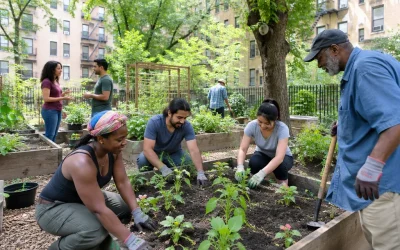
- Land: community gardens, tree planting and habitat restoration on religious property.
- Investment: divestment from fossil fuel companies; religious institutions make up a large share of the organizations that have announced such commitments.
- Certification: eco-congregation and “green church” schemes exist in Britain, Scandinavia, Germany and North America.
- Advocacy: networks such as Interfaith Power and Light in the United States mobilize congregations around energy and climate policy.
Sacred places as protected areas
Long before modern conservation law, religious norms protected land. In Ethiopia, Orthodox Christian churches are often surrounded by patches of native forest, the so-called church forests. In the heavily farmed northern highlands, these forests are among the last remnants of the original vegetation and serve as refuges for plants, birds and insects. Researchers and church communities have worked together to build stone walls around some of them to keep out grazing animals.
Sacred groves in India, temple lands in Southeast Asia, shrine forests in Japan and sacred natural sites in West Africa play a similar role. Many are small, but they often contain old trees, springs and species that have disappeared from the surrounding landscape. Conservation organizations now recognize them as a distinct category of protected area.
Why cultural ecologists take notice
Religious norms often outlast laws. A taboo on cutting a sacred grove, a fasting season that reduces meat consumption, or a pilgrimage route that keeps a landscape intact all shape ecosystems in ways that data on income and technology cannot explain. Religious communities also reach people that environmental groups do not, and they think in time spans of generations. That is why religion sits inside cultural ecology rather than beside it.
This site is an independent reference on cultural ecology. It is not affiliated with any religious coalition or with earlier organisations that used the NACCE name.
Frequently Asked Questions
What did Lynn White Jr. argue in 1967?
That Western Christianity’s view of human dominion over nature contributed to the environmental crisis, and that a religious rethinking was needed to address it.
What is Laudato si’?
Pope Francis’s 2015 encyclical on the environment, which treats climate change and ecological destruction as moral issues linked to poverty.
What are Ethiopian church forests?
Patches of native forest around Orthodox churches in Ethiopia, protected by religious tradition and now important refuges for biodiversity.
Why does religion matter for environmental protection?
Religious norms shape everyday behavior, often last longer than laws, and religious institutions own significant land, buildings and investments.